
Welcome to Black Sheep, a spin-off publication of my serialized memoir. SMIRK. While SMIRK was a deep dive into my unusual personal and professional relationship with one unique white-collar fraudster, Black Sheep takes a broader view and tells the stories of a wider range of business disasters (or themes potentially leading to business disasters).
If you’re looking for SMIRK, you can find the full table of contents and links to all the posts in chronological order here. Paid subscribers can access all the posts; free subscribers can access select posts. Thanks for reading!
There’s nothing conventionally “productive” about singing for me.
I’ll never be an “American Idol” contestant; it will never bring me financial rewards. Yet I spend several hours each week rehearsing with a chorus, learning new music, and practicing vocal techniques. Why? For the most human reason imaginable: because it’s fun.
The tech world almost completely discounts this basic human motivation (unless the fun itself is tech-related), with strange results. The other day, deep in my unmarketable musical pursuits, I opened a messaging app to coordinate with a few choir members. An AI chatbox promptly intruded, occupying the actionable portion of my screen. “Want tips on boosting your productivity?” it asked.
Besides being unwelcome, the question was unintentionally revealing. Boost productivity…how, exactly? By shaving a few seconds off a task that exists solely to support a hobby? If my time was so valuable, why was the bot getting in the way? And more to the point: productive toward what? What goal was this efficiency meant to serve?
In theory, productivity is a good thing. Most people like the feeling of accomplishing something of value, whether finishing a novel, launching a startup, or doing taxes. AI clearly offers methods to pare down busywork, leaving room for the bigger stuff: generating ideas, strategizing, decision-making, and also pleasures like socializing, daydreaming, and having fun. Again, in theory, AI should help us lead fuller and happier lives.
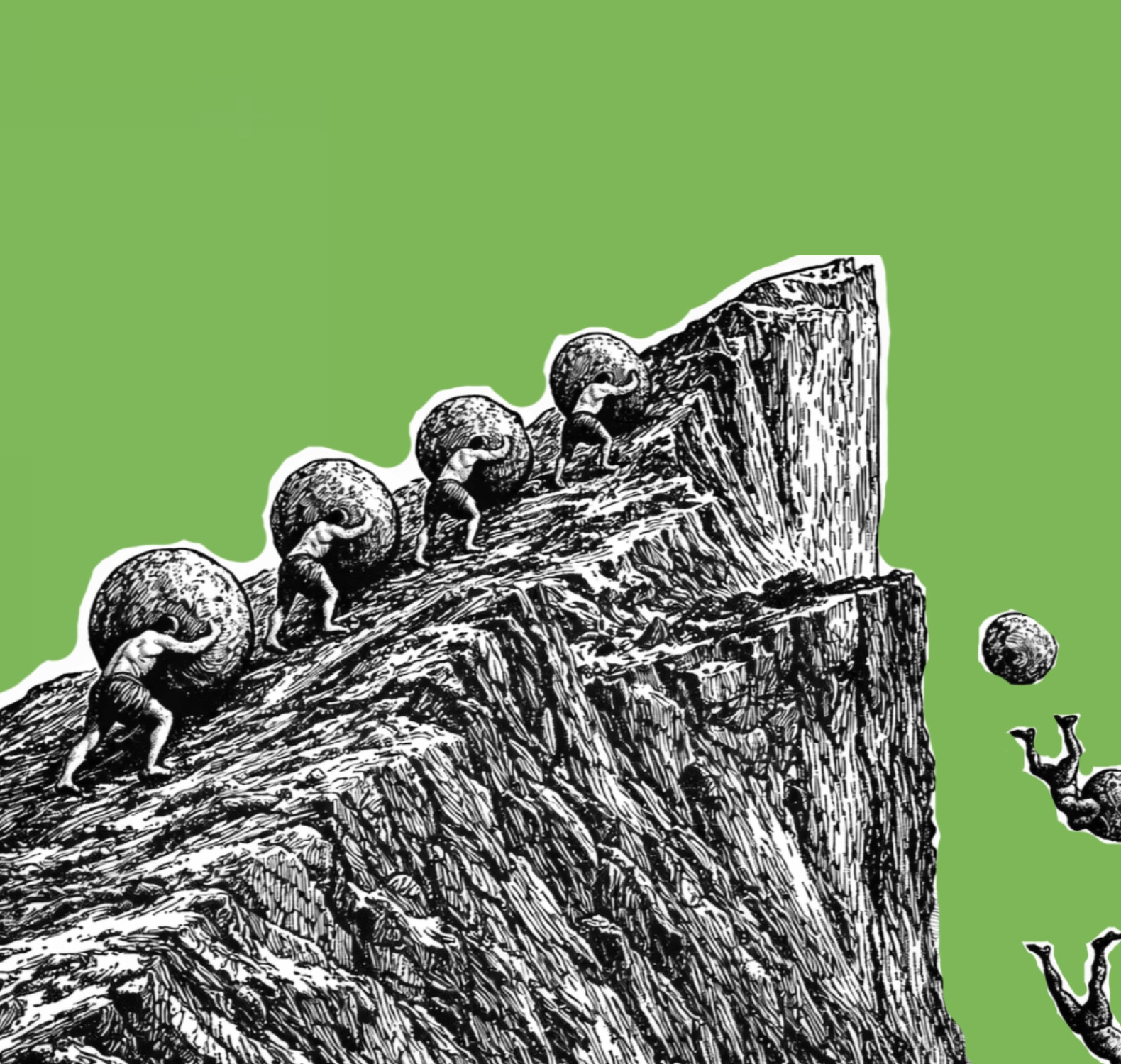
But it’s increasingly clear the reality is often different. Productivity has drifted from purpose. Passion and fulfillment are often left out of the conversation about work and are considered personal indulgences. The focus is on output. Downstream from Silicon Valley, where luminaries are still allowed to be intellectually expansive eccentrics with quaint habits (see Sam Altman’s enthusiasm for analog note-taking), the emphasis is on “optimization,” forward movement without direction, or as they say in tech lingo, “building,” without a direct object. What, exactly, is going on?
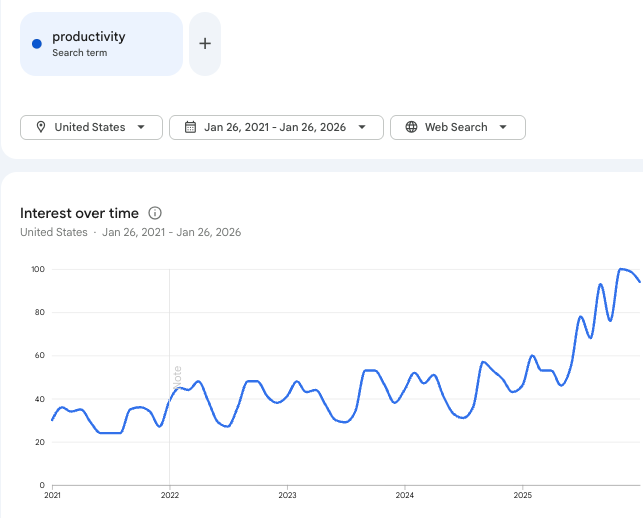
Lest you think I’m imagining things, there is data to support these notions sinking into our collective consciousness. Take Google Trends: searches for the word “productivity” are roughly four times higher than they were five years ago—an astonishing trajectory for such a boring term, especially considering how much chatbots have recently eaten away at traditional search volume.
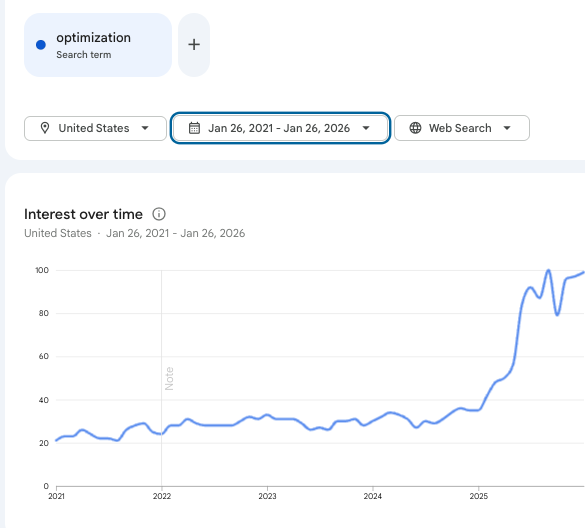
The trend line for “optimization” is even more extreme, as shown below.
Of course, these curves are unsurprising given what’s on social media these days. The messages on LinkedIn and Instagram are relentless: optimize your workflow, automate your life, master every aspect of AI, or be left behind.
We know it’s self-defeating to let productivity hype spread so far, without boundaries. When “doing more, faster” becomes the highest value, human needs, feelings, and aspirations look like inefficiencies. In that sense, one of AI’s more concerning risks is making us behave like machines, rather than machines taking on human-like intelligence.
Many people who do know better are stuck, constrained by economic necessity and forced to follow shifting management directives. Others have embraced the cognitive dissonance as an opportunity, pivoting themselves into AI evangelists and thought leaders. Some note the paradox that AI's productivity gains have generated new forms of busywork (learning prompts, managing tools, “staying current”), ensuring we never actually reach that promised land of freed-up time.
Part of the impetus behind the push comes straight from Marketing 101. The promise to “boost productivity,” detached from any understanding of what users actually want, relies on a tactic behavioral economists call manufactured necessity. Like deodorant ads insisting we smell bad, AI marketing suggests that anything done without automation is slow, naïve, or irresponsible. The underlying message is not “this might help,” but “you can’t afford not to do this,” because the cost of opting out is framed as irrelevance, unemployability, or obsolescence.
But there is something deeper at work as well. Productivity, stripped of direction and elevated into a moral obligation, begins to take on the contours of a belief system. It offers simple rules, repeated mantras, and a promise of salvation in the form of relevance or future-proofing. Doubt is reframed as an excuse. Exhaustion becomes an expectation. Participation is technically voluntary, but the penalties for opting out feel existential. In other words, it becomes a cult.
Americans love cults. From the radical Puritan Separatists who arrived on the Mayflower and Manifest Destiny-related sects, to effective altruists and MLMs, our society seems to constantly crave a sense of belonging and substitutes for purpose and critical thinking. Silicon Valley, itself, has often been described as a cult, with defined sub-sects like crypto bros, biohackers, and the people who almost literally worship AI like it’s a magical entity.
The Protestant work ethic described by sociologist Max Weber in 1904 has long been interlaced with our cults, with relentless labor being cast as a sacred and idle as sinful. When salvation is uncertain, work becomes both a distraction and proof of virtue. Today’s productivity gospel inherits this tradition in secular form.
AI has intensified underlying anxieties dramatically. Faced with rapid technological change and an unknowable labor market, many people respond by putting their heads down and working harder, trusting that constant productivity will somehow confer safety. In that sense, productivity has stopped being a measure of success and begun operating as a creed.
Against that backdrop, it’s not surprising that small acts of resistance are emerging. Some millennials and Gen-Zers are returning to actual religion, possibly as an antidote to the productivity rhetoric. Some get involved in community volunteering. Others seek release in reckless pursuits (for instance, young tech workers sparring with makeshift tasers). And some people, like me, spend hours each week singing, not because it advances a career or improves a metric, but because it does neither. It’s a time to just be human.
How do you preserve your humanity in the Age of Optimizing? Let me know in the comments below.
=


