

Welcome to Black Sheep, a spin‑off of my serialized memoir, SMIRK. If you’re looking for SMIRK, here’s the link to the complete book. Black Sheep is where I now follow similar themes of fraud and folly in other companies, industries, and individuals.
Superlatives are like siren songs to the middle of the bell curve, promising a brush with something special or extreme.
For marketing, they work like magic. Plenty of subpar restaurants stay in business by selling what someone has declared the “hottest” chili, the “tallest” stack of pancakes, or the “biggest” burger, no special culinary talent required. Small towns can claim fame by constructing comically oversized objects like the “World’s Largest” mailbox, cuckoo clock, or ball of twine. In fact, the “World’s Largest Ball of Twine” is so successful that America boasts at least three: in Darwin, Minnesota; Cawker City, Kansas; and Branson, Missouri.
But there can be serious downsides to being tagged with a superlative, and the inevitable influx of thrill-seeking masses that follows. Nowhere on Earth is this more obvious than on its highest peak, Mt. Everest.
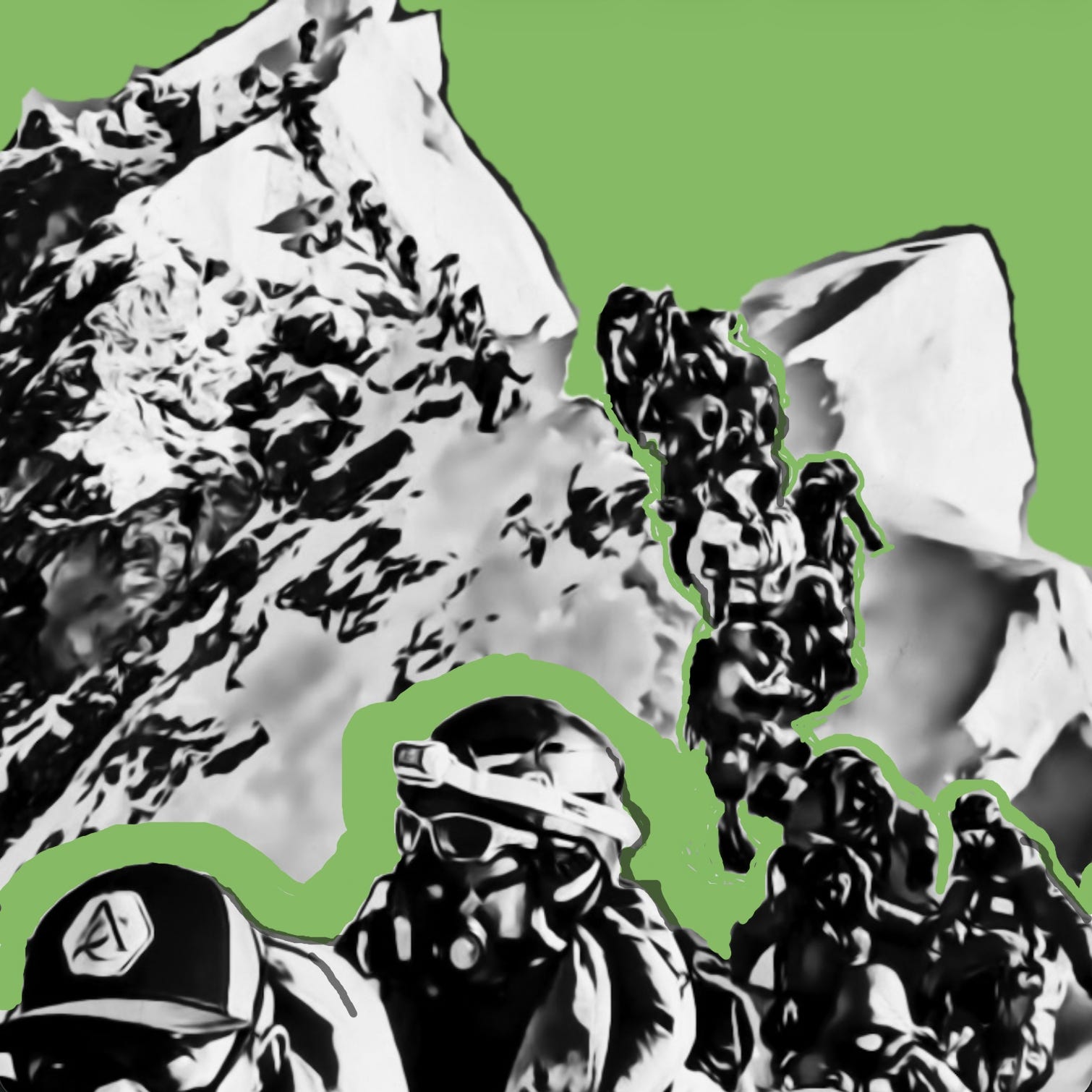
Every spring, when climbing season begins in the Himalayas, there are stories about the “traffic jam” on Everest, as hundreds of visitors take a crack at the mountain. Some are seasoned climbers, but the vast majority are amateurs, driven by a desire for bragging rights and maybe some “likes” on social media. Their exploits are made possible by an extensive industry of sherpas, other local guides, supply providers, and trained medical and emergency personnel.
While the steady stream of inexperienced mountaineers (typically paying $10,000s to over $100,000 each) has helped support Nepal’s economy, it has also left a devastating mark on a natural wonder. Photos abound documenting the extensive piles of trash — discarded oxygen tanks, food wrappers, water bottles, and God knows what else — scarring the scenery. There are also frozen remains of some unlucky climbers themselves. They serve as a reminder that the danger in scaling Everest is actually real, not just hype invented for tourist brochures.
With only a few routes to the summit doable for non-experts, crowds directly compound the risk. The air is so thin above 26,000 feet, the so-called “Death Zone,” that people’s bodies start breaking down from oxygen starvation, the brain swells, and the heart and lungs grow strained. Having to wait too long in line can literally kill you.
Of course, a fair number of the amateurs don’t make it far enough up the mountain to be exposed to those risks. Estimates vary, but available data indicate that at least a third of would‑be summit-seekers turn back early, often before setting foot in the Death Zone. The reasons range from sudden storms and illnesses, which can derail even seasoned mountaineers, to problems concentrated among the least experienced: inadequate gear, exhaustion, and altitude sickness. That context creates a different kind of vulnerability, apart from the elements: Rookie climbers become easy pickings for con artists.
*****
One could argue that I have no business poking around in the dealings of Everest adventurers. Apart from casual day hikes, I do not climb mountains. I have zero desire to spend weeks dragging gear up treacherous paths and sleeping in a frigid tent in pursuit of a summit. But I do find stories of these rigorous journeys compelling, and creative fraud in exotic locales even more so. That’s probably why a recent headline about the Everest scam grabbed my attention. I might not need to scale the mountain, but I did need to get to the bottom of whatever deeds were being orchestrated on it.
I first glimpsed the story in one of my Google alert emails, an April 2, 2026, piece from the UK’s Independent: “Everest guides accused of poisoning foreign climbers to force fake rescues in $20m scam.” According to the article, Nepali authorities had criminally charged 32 people in a case claiming widespread fraud by tour operators, who had allegedly conspired across the climbing ecosystem to stage hundreds of unnecessary helicopter rescues for insurance money. In some cases, complicit climbers may have agreed to take part in exchange for cut-rate expeditions. However, the Independent focused on the more scandalous claims involving unknowing participants: those who were allegedly poisoned.
According to the article, some guides staged the need for rescues by "lacing food with large amounts of baking soda,” uncooked chicken, or rat droppings, or giving some climbers “medications with excessive amounts of water.” This apparently led to nausea, dizziness, body aches, and other symptoms that mimicked or worsened existing altitude sickness, which the guides allegedly contended must be handled through emergency evacuations via helicopter. (Experts generally say the cure is simply to walk down and rest, not to summon a chopper.)
Before you ask, yes, I looked it up — you can get sick from consuming huge amounts of baking soda or overhydrating in a physically demanding environment without maintaining an appropriate salt balance. But that said, this information still left me with questions. First of all, baking soda has a very off-putting bitter taste. Shouldn’t a substantial amount of it in food be noticeable, even if the altitude messes with your senses a bit? Also, how much water would the guides have to push on trekkers to mess up their body chemistry? Liters? Both situations seem like they should raise red flags in any reasonably aware and skeptical person. (We will assume the dangers and grossness of uncooked chicken and rat droppings are even more obvious.)
Plain as day, I could see a plausible, unspoken narrative operating in the background: These amateur climbers, who came by the dozens, may have had no mountain sense and put their full faith in these guides, eating whatever gross-tasting food was served to them and following even the most counterintuitive instructions, like, “Here, if you’re feeling queasy, drink this entire two-liter bottle of water right now.” They might not have even done basic homework before embarking on the trek up the world’s highest peak; a cursory Google search could tell you how to fix altitude sickness. Maybe they didn’t express skepticism because they didn’t know enough to have any.
So I was torn: Clearly, insurance fraud and, even more so, poisoning people were serious crimes and moral wrongs. But was I supposed to feel sympathy for these “victims,” who had apparently made themselves into such easy marks?
****
It turned out that this alleged scheme had existed in some form for several years, with stories dating back to 2018.


