
Welcome to Black Sheep, a spin‑off of my serialized memoir, SMIRK. If you’re looking for SMIRK, here’s the link to the complete book. Black Sheep is where I now follow similar themes of fraud and folly in other companies, industries, and individuals. This piece is part of a series, and here is the link for Part I.
A Steer’s Last Day
One summer morning, while I was visiting my aunt’s farm, I helped her load King Richard III into a trailer to meet his end. He was a Dexter steer, the oldest in her small collection of cattle, and she had decided his day had come. He was headed to a Mennonite-run slaughterhouse, a humane alternative to large assembly-line processing plants. My aunt had carefully scheduled the trip to minimize how long King Richard III would have to wait before the Big Event. He had bad hooves, and she didn’t want him stuck for hours on concrete.
My aunt and her late husband had named him King Richard III because, like the British monarch immortalized by Shakespeare, he had congenital deformities. He was also born in winter, prompting them to think of the famous line from the play: “Now is the winter of our discontent.” It was a peculiar habit, naming animals you intended to kill for meat. But I also sensed a quiet bravery in confronting the moral consequences. A name conferred respect. Not everyone had the strength to show respect to an animal they intended to eat.
Dexter cattle are typically smaller and more compact than standard meat breeds, like Angus or Hereford. But King Richard III had grown into a giant among his peers, the size of several refrigerators. Standing in the mud that morning, trying to corral him away from the other steers, I felt both the practical danger and my City Slicker vulnerability. When he was finally in the trailer, with the door shut behind him, I was overwhelmed with a mix of pride and sorrow. That pang, I realized, was a hidden cost of raising livestock ethically.
Now, years later, looking at Agridime’s website, I think of that day. The framework, wrapped in an emotional attachment to how things should be, was exactly what the company was allegedly built to exploit. Agridime pitched itself as a way for ordinary people to invest in beef raised on local ranches, a way to make money and feel virtuous at the same time. As I explained in Part I of this story, the feel-good venture allegedly morphed into a $220 million Ponzi scheme, leaving investors empty-handed and triggering federal indictments. One of the key figures, Joshua Link, is now a fugitive; here, I trace how Agridime started and how it allegedly went off the rails.
Mysterious Beginnings
Despite multiple government investigations and extensive court records about the company, there is surprisingly little public information about Joshua Link’s life before Agridime. This opacity is striking given his role. Documents identify him as the co-founder and Executive Director, and in a prior regulatory probe, he described himself as effectively the company’s CEO, saying that he and the other co-founder, Jed Wood, were “where the buck stops” for all major decisions.
Court filings in the federal criminal case and related civil actions still shed no light on where Link came from or how he met Wood. What they do show is that Link and Wood organized Agridime LLC in Texas on April 13, 2017. Link, then in his mid‑20s, had clear ties to Missouri; in September 2018, he married his future co‑defendant, Tia, in Sedalia, where she had gone to high school. Over the years, he also had addresses in Gilbert, Arizona, and Hope, Kansas. Wood, by contrast, was a man in his 50s from Fort Worth, Texas, described in legal documents as Agridime’s President and Operations Director. He allegedly oversaw finances while Link drove sales.
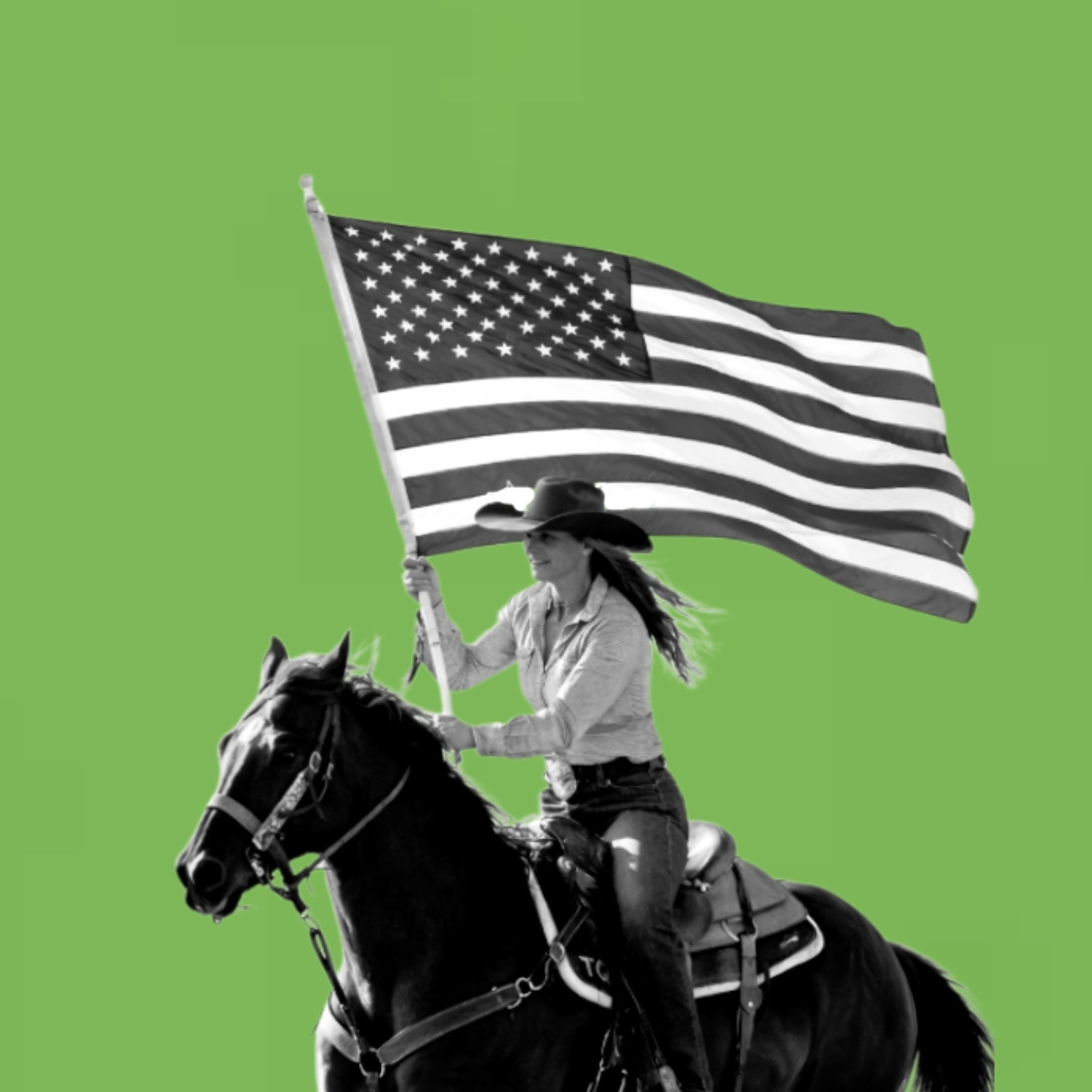
While the records don’t explain how the two men became business partners, their concept, on paper, sounded plausible: a way for investors to profit from cattle without doing the physical labor, while ostensibly supporting local agriculture. On its website, Agridime proclaimed “PRODUCING THE BEST MEAT FOR THE BEST PRICE. RAISED BY AMERICAN FARMERS,” with the text appearing over an image of a woman on horseback, in a cowboy hat, carrying a large American flag.

Agencies that later scrutinized the company, including the Department of Justice, the Securities and Exchange Commission, and the Commodity Futures Trading Commission, do not allege any fraud before 2021. Perhaps when Link and Wood launched Agridime, they believed in the model. But once the company gained a foothold, something — or someone — took a wrong turn.
The Pitch: “Everybody Wins”
Agridime started with no deep industry connections, no celebrity endorsements, and no massive initial outlay of funding. But it did have the benefit of the right cultural backdrop. The rise in “farm-to-table” dining, interest in high-quality grass-fed beef, and the idea of “using the whole animal” had flourished in the 2010s. Agridime’s pitch slotted neatly into that landscape, sounding persuasive to both investors and meat customers.
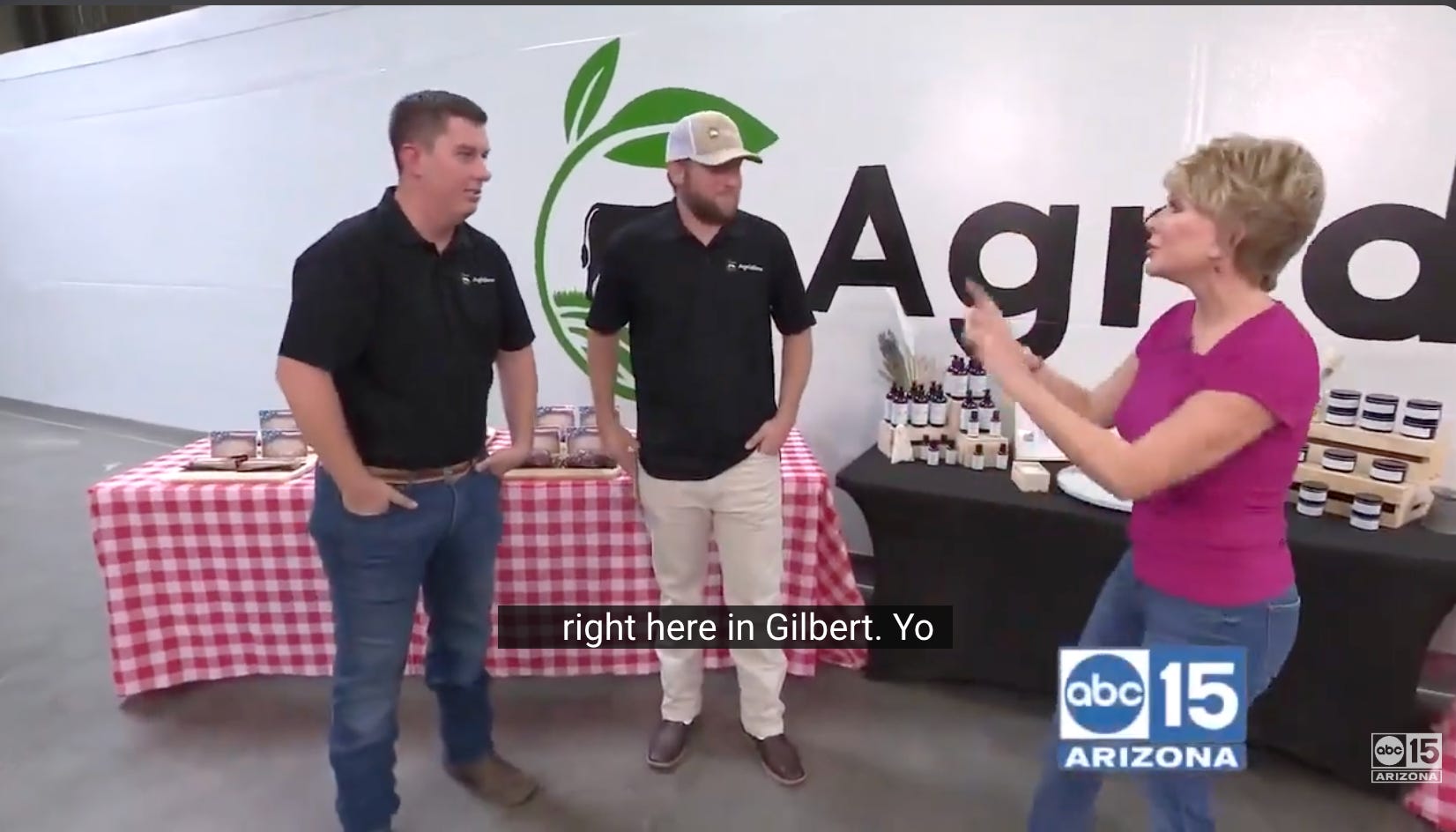
Using social media platforms like Facebook and YouTube as its primary marketing vehicles, the company successfully attracted the right attention. In 2022, a local television station ran a paid promotional interview with Link at a Gilbert, Arizona warehouse, where the co-founder claimed the company offered “the most nutrient dense protein on the planet.” Along with packages of meat, Link showcased the company’s offerings of tallow-based candles and cosmetics, which he described as a way to use “the whole carcass” and “respect” the animal.
YouTubers running investment-related channels also noticed the company’s frequent social media posts promising significant returns, which some commented on favorably. Reviewing information posted on Agridime’s website, one YouTuber posting in April 2022 offered mostly positive impressions to his audience of about 1,760 subscribers.
Although he refrained from explicitly recommending the investment, he noted the “guaranteed” return was higher than the S&P 500’s growth, adding that the company’s business model had “led them to grow rapidly since launch” and that it had established a “fully transparency and sustainable supply chain where everybody wins.” The YouTuber also repeated the company’s claims of being USDA licensed, saying that “the entire process of investment in Agridime is legally done,” that “all cattle are insured” against death loss, and that “this really gives a peace of mind for investors.”
Court documents included excerpts of the company’s marketing materials, providing a simple financial summary:
The cost per steer or heifer was $2,000, an amount that was purportedly supposed to include its feeding and care, plus meat processing costs. The cattle were supposed to yield an average of 500 pounds of beef each, sold at $6 per pound, for a total of $3,000. Of the profit, $600 was intended to go to Agridime and $300 to $400 to the investor, for a 15–20% return.
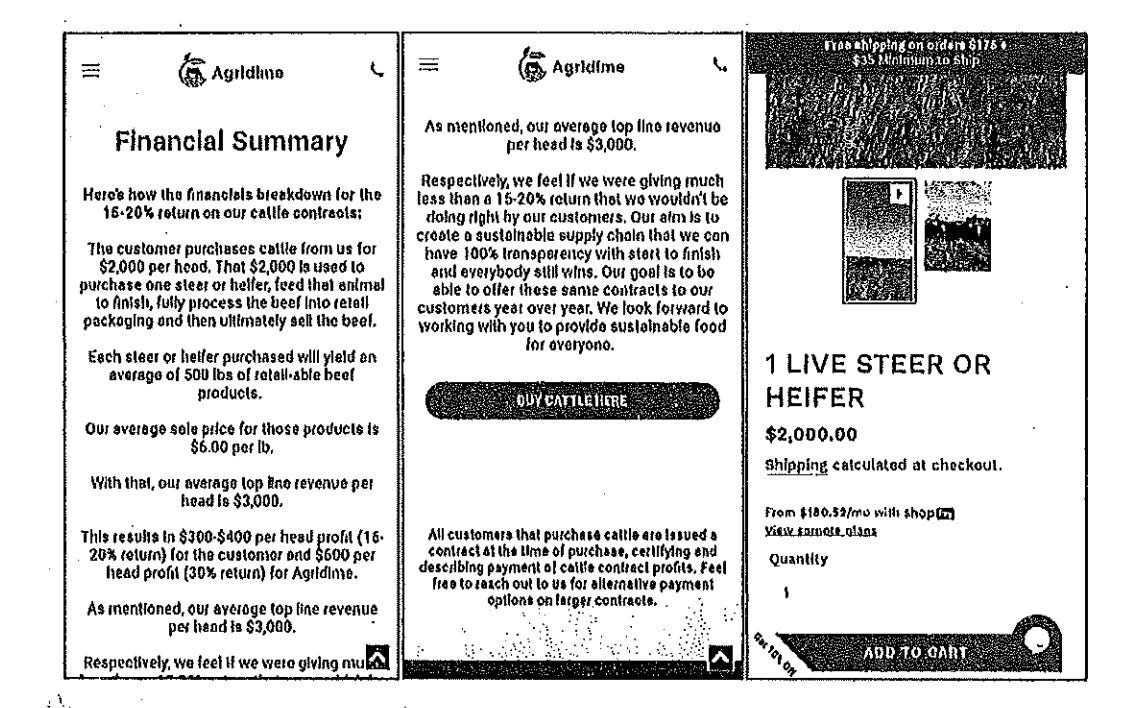
In the materials, the company states: “Respectively, we feel if we were giving much less than 15-20% return that we wouldn’t be doing right by our customers. Our aim to is to create a sustainable supply chain that we can have 100% transparency with start to finish and everybody still wins.”
For people who wanted to feel like the kind of person who supports sustainable farming, Agridime offered a shortcut, with interest.
Rapid Rise
All told, about 2,200 investors were lured by Agridime’s promises, according to documents submitted by prosecutors. While some were agricultural professionals, most were individuals scattered across at least 14 states, including Alabama, Arizona, Arkansas, Colorado, Indiana, Kansas, Kentucky, Maryland, North Dakota, Oklahoma, South Dakota, Texas, Washington, and Wisconsin. Investors typically bought dozens of cattle each, sinking $100,000 or more into Agridime, which was likely a substantial portion of their savings. According to prosecutors, the entire operation brought in $220 million from January 2021 through December 2023.
Through it all, Link was involved in nearly everything, including face-to-face meetings with investors, training sales staff, overseeing digital marketing, and negotiating contract terms, according to the court filings. His wife, Tia, worked closely with him as Agridime’s Marketing Director. As Agridime’s flow of investments grew, so did its operations. A LinkedIn page for Agridime lists a headquarters address in Fort Worth, Texas, and 12 employees. Its staff came to encompass a variety of administrative roles, including a financial controller, operations managers, and logistics personnel. In 2021, the company hired a North Dakota cattle broker, Taylor Bang, the owner of Taylor Bang Cattle Sales LLC. Some staff received generous compensation, particularly Bang. Regulators claimed Bang raked in almost $7 million in commissions from Agridime. Meanwhile, Link and his wife allegedly drew payments of more than $2.7 million.
Unstable Market
Most of us living in big cities don’t have to think too often about how wild swings in weather and other uncontrollable factors affect our food supply. But for small farmers and ranchers, these issues can be matters of economic life and death.
Just as Agridime was ramping up, conditions in the cattle market were shifting against it. Drought plagued much of the Western and Midwestern U.S. in 2021 and 2022, causing the price of animal feed to soar. Hay “was like gold,” my aunt told me, noting that it often had to be transported long distances at “a hideous profit.” Inflation also pushed up prices of various farming necessities, like diesel fuel. As a result, farmers liquidated their herds. Inventory levels dropped to their lowest levels in decades, while demand for beef continued unabated, causing prices to shoot up. For anyone trying to buy thousands of animals, as Agridime claimed to be doing on investors’ behalf, that meant paying more for each head, or not getting them at all.
Yet the company continued to tout a “guaranteed” return that supposedly covered “feeding that animal to finish,” as if these costs were static.
Problematic Math
And that brings us to Agridime’s simple return formula, which arguably should have been a big red flag for investors. Look harder at the costs involved, the probable revenue from selling meat, and most importantly the wide range of uncertainties, and the numbers start to look unrealistic.
Graze, a trade magazine for small ranchers, gives a hypothetical cost of just buying a 700‑pound calf at $1,600+, without even accounting for feeding, transport, and processing costs. With that in mind, a flat investment of $2,000 was unlikely to go far enough. Meanwhile, an expectation of 500 pounds of meat, selling at $6 per pound, for each animal was also highly optimistic. Agriculture researchers provide examples of 1,200‑pound steers typically yielding only 470 to 490 pounds of packaged beef. (As huge as he was, my aunt told me King Richard III netted just 530 pounds.)
But how were investors to know to question the data they were shown by Link and others at Agridime? After all, most were probably just City Slickers like me.
This concludes Part II. Click here for Part III.


