

Welcome to Black Sheep, a spin‑off of my serialized memoir, SMIRK. If you’re looking for SMIRK, here’s the link to the complete book. Black Sheep is where I now follow similar themes of fraud and folly in other companies, industries, and individuals.
Far From The City Lights
Every once in a while, you stumble across a fraud story that hits close to home. In this instance, I mean that very literally.
For almost 20 years, I’ve been a New Yorker. The city’s jarring cacophony of noises, smells, and humanity resonates with my nervous system in a way that most Americans will never understand. And that’s OK. New Yorkers don’t need or want everyone to come here.
But I didn’t start out surfing urban chaos. I grew up outside of Kansas City, Missouri, a stone’s throw from pastoral-looking scenes of cows and soybean fields. Like so many Hallmark movie protagonists, I had to escape all of that for bright city lights. Yet, it’s still embedded in my soul — the sense of being in the country, with a big sky overhead and undeveloped land unfurling as far as the eye can see. It’s part of what makes me me.
As a Big City reporter, I’ve covered Wall Street schemes and corporate scandals and brushed elbows with famous journalists, celebrities, and power brokers in Manhattan courthouses. So I couldn’t help but smile a little when I saw news of a major financial crime near my hometown. It involved a Missouri man who allegedly ran a $220 million cattle scam.

Most-Wanted Cattle Man
The indictment was unsealed on Feb. 12, 2026, in Fort Worth, Texas, federal court. It charged five individuals with assorted crimes over their alleged roles in a scheme to fleece cattle investors. The group was involved in a business called Agridime, which allegedly promised to channel funds into purchasing steers on local ranchers’ farms, and provide returns of 15% to 32% when the animals were eventually slaughtered for meat.
Instead, according to prosecutors, Agridime operated as a Ponzi scheme, purchasing very few actual animals and simply repaying old investors with newer investors’ funds. The scheme, spanning multiple states including Texas, Missouri, and North Dakota, totaled $220 million from 2021 through 2023, with defendants extracting millions of dollars for themselves, according to the indictment. More than 2,000 investors ended up losing at least $115 million, prosecutors alleged.
Curiously, while four of the defendants were arrested, one remained at large. The holdout was a 30-something Missouri man, Agridime co-owner Joshua Link. News sources highlighted how he was a fugitive, providing links to his FBI wanted poster:
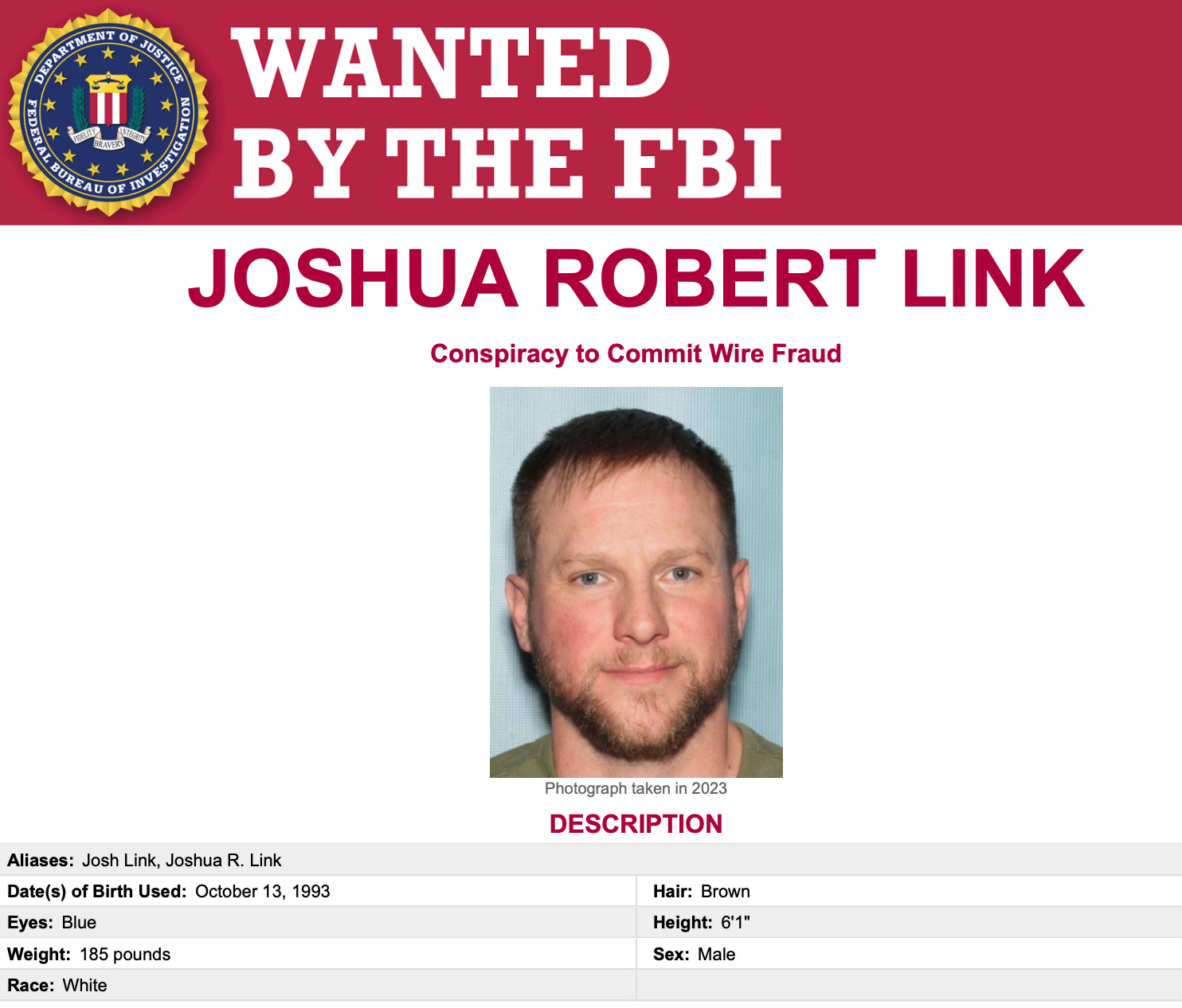
Nothing evokes the historic Wild West quite like a guy being on the lam, wanted for cattle fraud. The U.S. Attorney’s release, the charges, and the poster captivated me and jarred me out of my preoccupation with big-city hustlers. There was something oddly affirming, given my own background, about recognizing equally complex swindles in America’s Heartland.
At first glance, the pattern of what Link and his compatriots were accused of looked standard: overpromising, wildly under-delivering, and pocketing some of the ample cash flowing through the scheme based on these deceptions. But the documents couldn’t tell me how, exactly, Agridime had grown from nothing into an operation siphoning in hundreds of millions of dollars in just a few years. That question hooked me.
Anyone who’s ever tried to raise money for anything, be it a hedge fund, a tech startup, or virtually any other endeavor, knows it’s no easy feat getting outsiders to sink ample quantities of money into a venture with no proven track record. Winning trust often relies on shorthand signals of legitimacy, such as the founder coming from a top Ivy League school, having famous friends, being named to a “30 under 30” list, or otherwise generating media attention. Old-fashioned nepotism can work, too.
The folks at Agridime had none of those special qualities, and yet, according to prosecutors, they somehow sweet-talked $220 million out of people. This didn’t sound like the work of a country rube. Someone with the finesse of a Jordan Belfort or a Bernie Madoff had to be involved, acting as a rainmaker. Based on everything I read in the court documents, his sudden disappearance, and the cool, even stare captured in his wanted poster, I sensed the lynchpin of the alleged scheme was Link.
Tia & Josh
While there was a flurry of local news reports on the indictment and on Agridime, no journalist had taken a close look at Link. So I did. When I started poking at the threads, a dark and intriguing tangle emerged.
The indictment named five individuals, hailing from locations sprawled across the midsection of the country:
Jed Wood of Fort Worth, Texas; charged with three counts of wire fraud, one count of conspiracy to commit wire fraud, and one count of money laundering.
Taylor Bang of Kildeer, North Dakota; charged with eight counts of wire fraud, one count of conspiracy to commit wire fraud, and one count of money laundering.
Royana Thomas of Arlington, Texas; charged with six counts of wire fraud, one count of conspiracy to commit wire fraud, and one count of money laundering.
Joshua Link, of Strafford, Missouri; charged with 10 counts of wire fraud, one count of conspiracy to commit wire fraud, and two counts of money laundering.
Tia Link of Smithton, Missouri; charged with three counts of wire fraud, one count of conspiracy to commit wire fraud, and one count of money laundering.
While Josh and Tia had the same last name, neither the indictment nor an earlier filed criminal complaint specified their relationship, whether spouses, siblings, or otherwise. Tia Link was also known as “Tia Makenzie Shane,” according to the indictment, though it did not note whether either “Shane” or “Link” was a married name. It was a small detail that hinted at a deeper backstory.
I noted their alleged residences, in Smithton and Strafford, were about two hours apart, mostly a straight shot from each other along I-65, and theoretically doable for a couple that didn’t mind commuting.
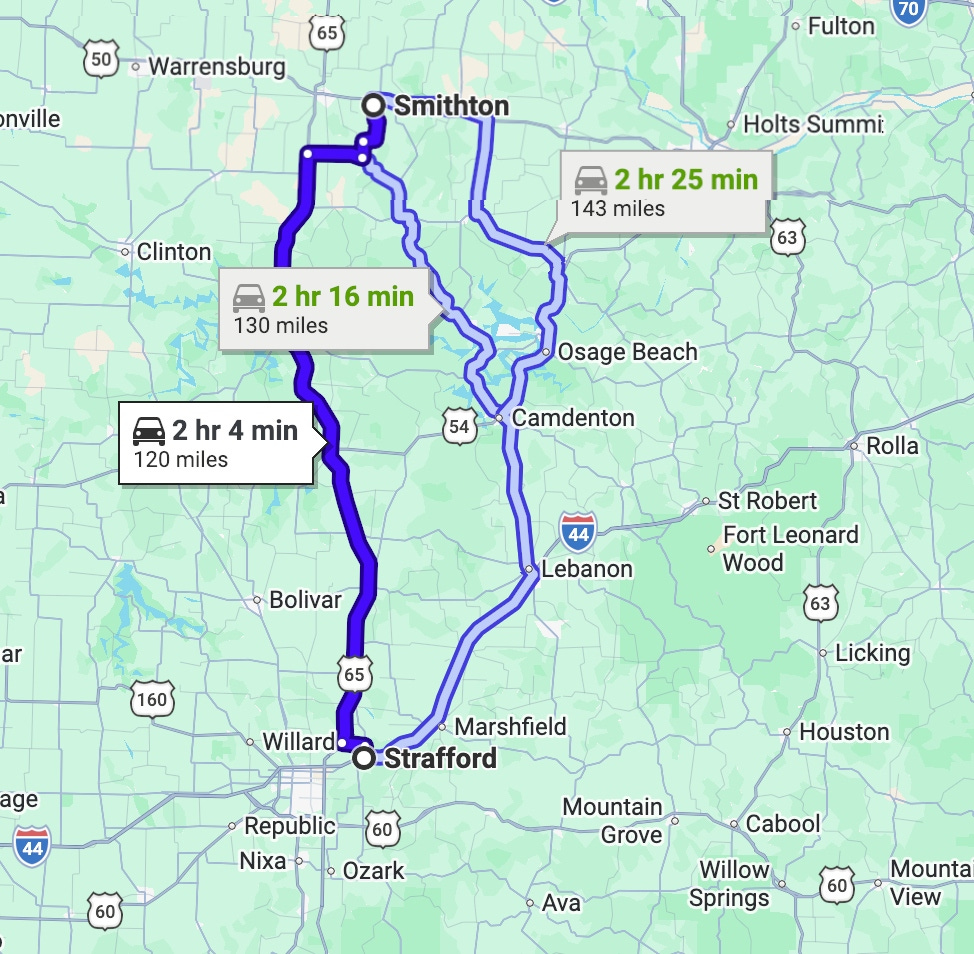
I had driven that very stretch of interstate myself many times while attending college at Mizzou, in the early 2000s. My parents were living in Ozark at the time, not far from Strafford. Brightly lit with numerous billboards for Jesus, smut shops, and anti-abortion campaigns, it was, from what I recall, a relatively easy trek.
Obviously, Item 1 for me was determining if Josh and Tia were, indeed, married. Fortunately, the answer took only one two-second Google search for “Tia Shane” and “Josh Link.” The star-crossed pair had left up their Zola wedding website.

A Labor Of Love?
The website is scant on details. It provides the basics for the Big Day — Sept. 18, 2018, in Sedalia, Missouri — links to Amazon and Target gift registries, an RSVP link, and an assortment of photos. At the time, Link was nearing 25. Tia was a couple of years younger, a former high school volleyball player for a small Christian school in Sedalia.
The website for Heritage Ranch, where the event was held, included a video of the Links’ wedding. It shows a charming but modest affair; three bridesmaids in dusty pink, three groomsmen in shirtsleeves, Tia beaming in a spaghetti-strap gown with a plunging neckline, and Josh smiling back at her lovingly in a straightforward suit and tie. Their ceremony was held amid lush greenery, and the reception in a barn strung with fairy lights.
Now, professional wedding videos typically show an idealized version of the day. A videographer who made a wedding seem unpleasant or highlighted points of tension probably wouldn’t stay in business. Even with those caveats, I noticed no obvious red flags. Guests appeared relaxed. Expressions of joy and surprise seemed sincere. Children danced. People hugged. Nothing seemed over-the-top, “too perfect” or forced.
Looking at the video, I doubt that anyone present at the scene — maybe even that happy couple — had any sense of what disastrous path this was leading toward. It seems unlikely, for instance, that any gossipy relatives were lurking in corners, taking bets on how long the marriage would last. Surely, no one guessed that the bride would end up in handcuffs and the groom a fugitive.
But judging by the timeline captured in court documents, the wheels were already in motion by the time the pair said their “I do’s.” Just a year and a half earlier, in April 2017, Josh Link had co-founded Agridime, the venture that would ultimately make him a wanted man.
This concludes Part I of “A Ponzi Scheme On The Prairie.” Click here for Part II.
CORRECTION: I accidentally misgendered the cattle pictured in the main image. Actual comment from my aunt: “Them are steers, not cows. Jeez, city people.”
The error has been corrected.


