

Welcome to Black Sheep, a spin‑off of my serialized memoir, SMIRK. If you’re looking for SMIRK, here’s the link to the complete book. Black Sheep is where I now follow similar themes of fraud and folly in other companies, industries, and individuals.
Somewhere in the distance, you might hear a rasping snort. That’s me cackling. I’ve been doing it nonstop for days ever since Jensen Huang was forced to step down from Nvidia. The CEO, always clad in a cool leather jacket in photos with tech bros on LinkedIn, turned his chipmaker into the backbone of the AI boom. As valuations soared into the stratosphere, he was cast as the pragmatic industry veteran who kept all the future-tense proclamations anchored to something solid: real cash flow.
And then what happened? Well, we know what happened (I’m cackling again). Pardon the crudeness, but this social media comment is (chef’s kiss) almost too perfect. It’s also been repeated so many times now, across different platforms, I don’t even know who deserves the original credit, but this post on Reddit seems to be among the earliest: “Can’t believe Jensen popped the AI bubble with his d*ck.”
That’s right. After an initial bombshell revelation that he’d had an affair with a suspected Chinese spy (making all the tech billionaires’ fearmongering about China beating us in the AI race laughably ironic), reports soon emerged about more philandering by Huang, with two of his own employees. The market, and Huang, might have shaken off one honeypot hitting the news, but three in rapid succession? Well, it wasn’t too long before the fallout became impossible to ignore.

Speculation also emerged about his wife, Lori, not having a prenuptial agreement, potentially entitling her to half of Huang’s $140 billion-ish fortune and portending more shocks for the economy. It did seem she deserved it, if not for her husband’s cheating, then for how his actions unleashed a wave of tech-bro misogyny directed at her appearance, as if her being a 65-year-old woman somehow made it OK for her similarly aged husband to go around collecting younger side-pieces.
Perhaps not helping matters for Jensen, one of his loudest defenders was Elon Musk. The world’s richest man, who doesn’t even bother pretending to be more evolved than a silverback gorilla with a troop of dozens of mates, declared it would “be an honor” to hire the now-disgraced Huang. What he lacked in dignity, however, Huang apparently made up for in enough morality to be disgusted with himself. According to Bloomberg, Huang told people at Nvidia that he was a “piece of sh*t” just before he resigned.
When I last wrote about Huang on Black Sheep in January 2026, he had been riding high as a bulwark of AI’s resilience. Now, he had become the punchline of an SNL cold open. The arc was pure Greek tragedy, revealing how hubris itself could be an inevitable Achilles’ heel. Even Huang’s omnipresent leather jacket, which I had previously described as a kind of economic totem, didn’t escape the carnage. Observers on social media joked that no CEO would ever be able to wear one again.
So far, the impact hasn’t been catastrophic. But past boom-and-bust cycles don’t offer reassurance. Downturns don’t begin with a massive stock market crash — that’s more a symptom than a cause. Instead, they develop gradually as tension builds up, like pressure behind a dam. Cracks develop until the whole structure suddenly gives way. Huang’s sweeping marital infidelity was one hell of a crack to get things started. A quick recap of the other factors in play:
Major AI companies, i.e., OpenAI and Anthropic, continue to burn cash by the truckload, with the prospects of breaking even pushed further into the future.
Economic reports have noted that many industries outside of tech have yet to show returns from AI investment.
Debt associated with the AI buildout continues to mount, becoming dangerously analogous to the financial sector’s web of robbing Peter to pay Paul in the lead-up to the real estate crash in 2008.
AI continues to be vastly unpopular with most ordinary people, many of whom experience its “benefits” primarily as something that might replace their jobs in the future, and see its infrastructure — namely data centers — as a blight on the planet.
Democratic majorities secured in both the House and Senate for the coming year come with almost a guarantee of increased scrutiny of the tech sector, and AI in particular, with plans for more regulations already in the works.
Laws and regulations that already exist can be invoked to launch potentially damaging investigations, with Nvidia’s independent directors already hiring outside lawyers to investigate the alleged spy canoodling.
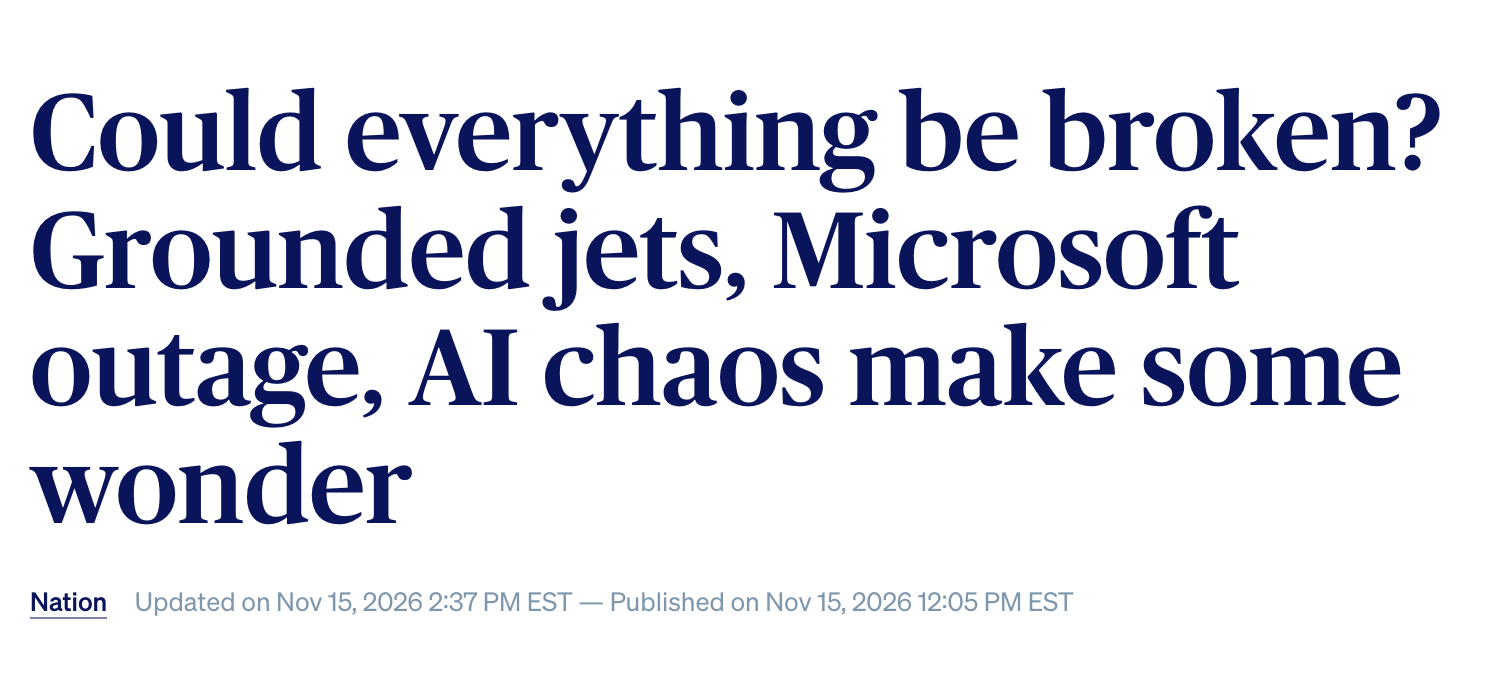
But the most significant contributor of all is the shift in sentiment. When so much of the market rests on future expectations, a widespread belief that tech industry titans are just a bunch of naked emperors leading us all off a cliff can become a self-fulfilling prophecy. As if on cue, within a couple of days of the Nvidia sex drama forcing Huang’s departure, a widespread Microsoft Outlook outage and sudden nationwide grounding of flights sparked rumors of the whole industry collapsing, even though neither of those events had anything really to do with Nvidia or even each other.
The Associated Press even published a roundup of semi-conspiracy theorizing over the mess, called “Could Everything Be Broken?” A version appeared on the PBS NewsHour website below:
While sex scandals weren’t the catalyst, past bubble pops had shapes like this, too. There were a number of early warning signs before the dot-com bust, including the rapid rise and implosion of once-exciting e-commerce ventures like Pets.com. Lots of weird little trouble indicators also emerged before the 2008 crisis. One of them I recall clearly, as a former real estate reporter in Tucson, Arizona, at the time, was real estate agents verbally attacking the press and calling me to debate math as median and average prices started to dip. Subprime lenders started to falter, too, unsurprisingly, since the borrowers they served often had very little capacity to repay them.
If we are headed into a downturn (again, I can’t by any means say for sure), this doesn’t mean it’s over for AI. For all we know, the tech could become even more ubiquitous as companies cut jobs out of true economic necessity, or somehow power a brighter future. But we do know that whatever the robots do, the people who are building out the infrastructure for them are only human. Their fallibility remains fundamental to whatever tomorrow brings.


