

Welcome to Black Sheep, a spin‑off of my serialized memoir, SMIRK. If you’re looking for SMIRK, here’s the link to the complete book. Black Sheep is where I now follow similar themes of fraud and folly in other companies, industries, and individuals.
Practically everyone involved in content-making has felt some version of social-media-induced urgency to make the most of every brief moment of collective human attention, and push out as much as possible, as fast as possible. The result we experience as an audience is over-saturation, books, songs and movies with clickbait titles and little substance, and the appearance of certain names and faces suddenly everywhere, as publicists and journalists milk the moment. The bonfire burns bright and hot only to suddenly die down, go cold, and not return until another viral event rekindles it.
A24 has done something completely different with its Elizabeth Holmes documentary. The production company bided its time, unveiling it only after the social media world had nearly forgotten the imprisoned Theranos CEO, using the element of surprise plus the promise of something exclusive and salacious to generate its own news hook. The plan worked amazingly well, though I was not especially surprised. I’m well aware A24 has also been hoarding a similarly immersive Martin Shkreli documentary (given that I was interviewed extensively for it); but more on that later.
As much as I admire the strategy behind its release, I’m less sold on the Holmes doc itself. With the provocative title, “You Can See Everything,” the premise is that the disgraced blood-testing company founder gave a huge amount of access to the filmmakers, including comedian and offbeat interviewer Nathan Fielder, during the 34 days before she reported to prison to serve her 11-year fraud sentence. Supposedly, she did it to push back against media narratives spun in earlier Theranos documentaries and the Hulu series “The Dropout.” A 90-second teaser clip released for the film indicated that’s not what actually happened; it shows a weird tête-à-tête between Holmes and Fielder, where she responds to his dramatically slack-jawed incredulity with wide, nearly unblinking blue eyes and comments that give the impression, in this particular context, of waving a giant sign saying “I’M A LYING SOCIOPATH.”

So yeah, it’s probably not going to do much to repair her reputation.
More importantly, though, looking at this as a journalist especially, I wonder: Is this film going to give us anything close to useful and salient truth? I have serious doubts. First of all, this type of work is seated within a category I like to refer to as “gimmick documentaries,” where instead of a relatively straight narrative, a filmmaker uses some sort of participatory set-up where he or she becomes a main character. Think Michael Moore and “Bowling for Columbine” or Morgan Spurlock and “Super Size Me.” This category also encompasses documentaries like Sacha Baron Cohen’s “Borat,” where the filmmaker takes on a fictional persona to essentially prank his or her subjects and get them to reveal something candid.
But more often than not with this style of work, heavy-handed or dishonest editing can turn it into another piece of fiction, propagating a new myth rather than anything that exposes real insight. Spurlock, for example, made audiences believe that he was “pickling his liver,” as a doctor called it, by eating nothing but McDonald’s for weeks, the experiment he performed on himself to give a narrative backbone to the film. Years later, the truth came out: Spurlock was a raging alcoholic who drank heavily during the filming. When the doctor remarked on camera that testing showed Spurlock’s liver looked “like an alcoholic’s after a binge,” he was more accurate than he realized.
Then there’s the other problem with the Holmes doc: Nathan Fielder. It’s not that he’s a comedian who interjects himself into serious topics. Shakespeare’s Fools were often a vehicle for truth, and so are ours. See “The Daily Show,” “SNL,” “Last Week Tonight,” The Onion, the Babylon Bee, and so on. It’s not even that Fielder sometimes exploits unsuspecting humans in pursuit of comedy. That’s a page straight out of Baron Cohen’s playbook, and I have enjoyed his films.
Here’s the thing: Though Baron Cohen duped and mocked people throughout “Borat,” he at least provided reliable cues to the audience over whether a joke was being made at someone’s expense. As a filmmaker, Baron Cohen can at least theoretically be made to confront his choices, and explain whether they were justified. (Most of us might agree maybe so for many of the American subjects, and probably not for the Central Asian villagers he tricked into participating.) Fielder is different; he is shiftier, vague about his intentions even to the audience, and seems to weave between sincerity and humor in a way that feels unsettling and possibly cruel, not amusing or revelatory. Or at least not to me.
I have tried on multiple occasions, including just before writing this post, to watch his shows “Nathan for You” and “The Rehearsal.” I can’t get through more than five minutes of either without squirming and having to shut it off. If you’re unaware, “Nathan for You” was Fielder’s satirical docu-series where he pretends to be an expert consultant and gives struggling small-business owners preposterous marketing advice. The humor stems from the befuddled reactions of the business owners, who supposedly believe Fielder is sincerely trying to help.
The specific episode I tried repeatedly to get through, and failed, involved him convincing a frozen yogurt shop owner to offer a “poo”-flavored yogurt as a publicity stunt. I got far enough into the show to watch Fielder fake being shocked by a professional publicist telling him what a terrible idea it was. But I couldn’t make it past Fielder belatedly “discovering” that anything feces-like in a restaurant is inherently repulsive, and explaining his supposed new insight to the yogurt shop owner, who by then was probably deeply regretting his participation in the show.
I tolerated even less of “The Rehearsal,” which revolves around bizarre social experiments where situations are painstakingly engineered and “rehearsed” and then carried out in real life. From the moment the human subject of the first episode appeared on the screen, I was uneasy. He was a warm, earnest man who loved knowledge and trivia, but had lied to his trivia team about his educational background, claiming advanced degrees he lacked. Fielder had arrived supposedly to help this man come clean to his trivia team. As soon as Fielder started explaining how he approached his conversation with the subject by creating an exact replica of the interior of his house, and “rehearsing” the meeting with a hired actor, I couldn’t watch any more. It was just too creepy. The subject already seemed like he was being set up as a sacrificial lamb and I had no interest in watching the carnage.
I also tried to watch a clip where Fielder was interviewed by Wolf Blitzer and Pamela Brown on CNN about an episode of “The Rehearsal” dealing with airline safety. I couldn’t get far into that either, feeling too unbalanced by Fielder’s wandering facial expressions and tone of voice. Was this a gag, like some Andy Kaufman-esque, surreal attack on cable news (a worthy target)? Or a sincere attempt to expose a dangerous trend he had uncovered? It was too ambiguous.
To be fair, Fielder’s résumé of semi-fabulism provides built-in entertainment value as a Holmes interviewer — a sort of “it takes a con artist to know a con artist” sense that works as a storytelling paradigm. The short clip released publicly has already proven to have massive meme traction, with numerous people superimposing their own symbolism on Fielder, with his intensely stunned expression, and Holmes, with her serene (and perhaps artificially low-voiced) assertion: “I’m engaging with you as a human being. Why would I deceive you?” Which of these two is more fake? It’s really anyone’s guess.
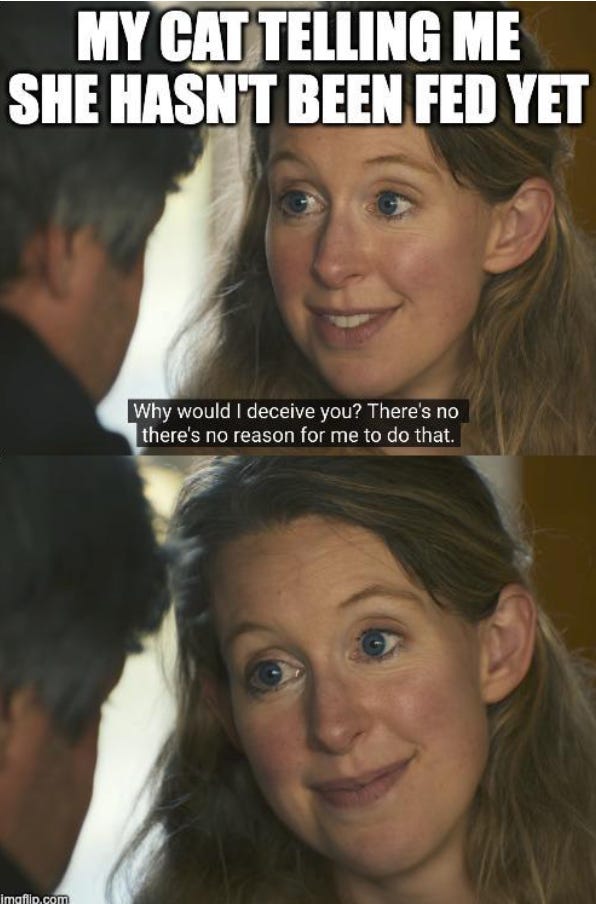
But is this really shedding any new light on Holmes? Her story has been exhaustively investigated in both the media and the courts, and the fraud for which she was convicted caused enormous direct and societal harm. She has been portrayed in complex ways: as an ambitious fraudster, as a woman subject to manipulation herself, and as some combination of villain and victim. What potentially unseen reality are we getting a window into through Fielder? Mostly, it seems, a profoundly destabilizing moment where a woman who once graced magazine covers as “the next Steve Jobs” is preparing to spend a decade behind bars. Someone is bound to act odd in those circumstances, with or without a documentary crew present.
Which brings me back to that Martin Shkreli documentary lurking somewhere in A24’s library, and why I am not sure it will ever see the light of day.
Martin, as you might remember, or can read more about in SMIRK, was extraordinarily hostile to the media as the viral spotlight continued to shine on him over his drug price hikes and securities fraud conviction. He was just as nasty toward many would-be documentary makers, quickly dissecting their approaches as dishonest, manipulative, or voyeuristic. Though one documentary, “Pharma Bro,” did get out into the world, mostly via sheer determination by the filmmaker, Brent Hodge, Martin did not participate at all. Throughout the film, he is seen only through excerpts of his livestream videos and media coverage.
However, as Martin was nearing release from prison, he did engage with one filmmaker — an old friend of his from high school, who was working in Hollywood. The filmmaker caught Martin leaving prison and working on putting his life back together in some form or another over the ensuing weeks. Martin and I were no longer dating at the time, but I agreed to be interviewed, to be filmed interacting with Martin, and to help “Shkreli wrangle” occasionally. Martin notoriously lives in a logistical cloud of his own creation, and getting him to appear in certain places or do certain things as needed on a filming schedule did take a skill that I seem to uniquely possess.
There was no wacky comedian, no elaborate prank, no artificial experiment designed to produce a reaction. The hook, if there was one, was simply access: a person who had spent years snubbing documentary filmmakers allowed an old friend to follow him at one of the strangest and most vulnerable periods of his life.
That may also present A24 with a very different set of variables than it had with Holmes. A famous, convicted fraudster subjecting herself to weeks of intimate, awkward interrogation before heading to prison can obviously generate numerous memes and headlines, with judgment already passed and sensationalism seeding curiosity. A documentary that simply watches a notorious person emerge from prison and attempt to get back on track is harder to package, particularly if what it captures doesn’t conform neatly to the character the audience already knows.
Of course, one can never say mid-production how exactly a documentary will turn out, but late into the process one of the producers told me she had seen a rough cut, and it left her with tears in her eyes.
It wasn’t a gimmick, or a prank, or a myth. It was real.
A24 may be sitting on it, strategically waiting for a moment when audiences will be ready for that kind of thing, but who knows if it will ever come.


