

Welcome to Black Sheep, a spin‑off of my serialized memoir, SMIRK. If you’re looking for SMIRK, here’s the link to the complete book. Black Sheep is where I now follow similar themes of fraud and folly in other companies, industries, and individuals.
Seven years after it ended, HBO’s “Silicon Valley” remains the most searing satire of the tech industry. Many of its scenes still feel fresh. One clip from the 2019 season, in which Gilfoyle’s bot “Son of Anton” deletes code bases as the “most efficient” way of fixing bugs, and orders 4,000 pounds of meat when tasked with finding cheap hamburgers, has taken on a second life as a viral critique of today’s AI.
But the show’s deeper theme is even more enduringly relevant. Every founder, at first, is some version of scrappy hero Richard Hendricks, trying to beat the odds and turn a brilliant concept into reality. If they’re successful, though, they risk becoming Gavin Belson: ensconced in privilege, surrounded by yes-men, high on their own superiority complexes, and constantly throwing their power behind bad ideas they no longer know how to gut-check.
Let’s look at where Mark Zuckerberg falls on this continuum.
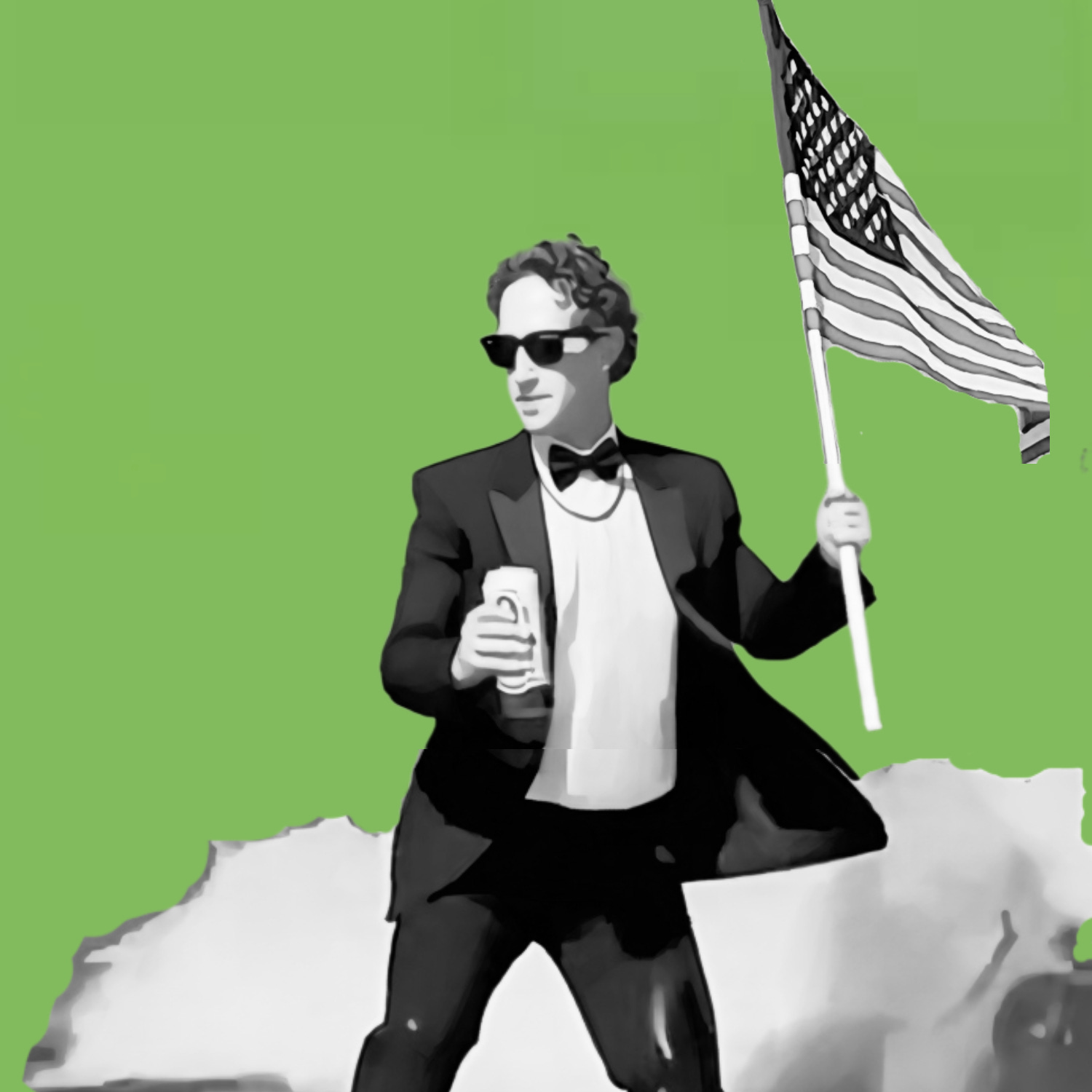
When I was in college, I knew him as the Facebook founder wunderkind, decked in a hoodie, building something that, for better or worse, changed the world. Now what is he doing? Apparently practicing jiu-jitsu for hours each day, raising, hunting, and slaughtering his own meat, dramatically engaging in watersports (as seen above), forging Japanese swords, and nurturing fantasies about becoming an MMA star.
Oh yes, and still running his $1 trillion-ish, 70,000-headcount company, which as of late has descended into turmoil and revolt. First, he changed the name to “Meta” in 2021 on a bet that everyone would soon be living and working in a virtual reality “metaverse.” That was a dud. More recently, he took a similar headfirst dive into AI, shifting 7,000 workers and billions of dollars toward Llama, its AI Superintelligence Labs, and other projects. Though AI overall is significantly more promising than the metaverse, this has nonetheless gone poorly for Meta.
First, the company’s lost its chief AI scientist, Yann LeCun, over his concerns that Meta’s priorities for AI development were short-sighted, and too focused on LLMs rather than building more comprehensive visual-based AI. Then, like turning a shower knob that can only do “hot” or “cold” and no in between, the company at first encouraged massive “tokenmaxxing,” or using AI as much as possible for every single task, no matter how complex or mundane. Then, as tens of billions of dollars in costs stacked up, Meta rapidly shifted almost 180 degrees, suddenly throttling AI usage, according to The Information.
On top of the whiplash, the company conducted a mass layoff in May 2026, axing 8,000 employees, or roughly 10% of its workforce. The workers were told in a memo from HR that the cost-cutting was needed to “run the company more efficiently” and “offset other investments we’re making.” Zuckerberg directly tied the move to the company’s AI ambitions, saying “we’re transforming the company.” Meanwhile, misery reportedly increased for everyone who was spared.
According to Wired, an employee described the atmosphere as “literally the gulag.” Engineers claimed they had been forced into repetitive tasks, like labeling data, creating puzzles for AI, and ranking outputs, which shattered their sense of autonomy and purpose. At least one worker interrupted an internal meeting with an expletive-laced rant, while others distributed flyers and signed a petition against new employee-tracking for training data, Reuters reported. According to Business Insider, CTO Andrew "Boz" Bosworth later admitted morale was “among the worst it’s ever been” in the company’s history.
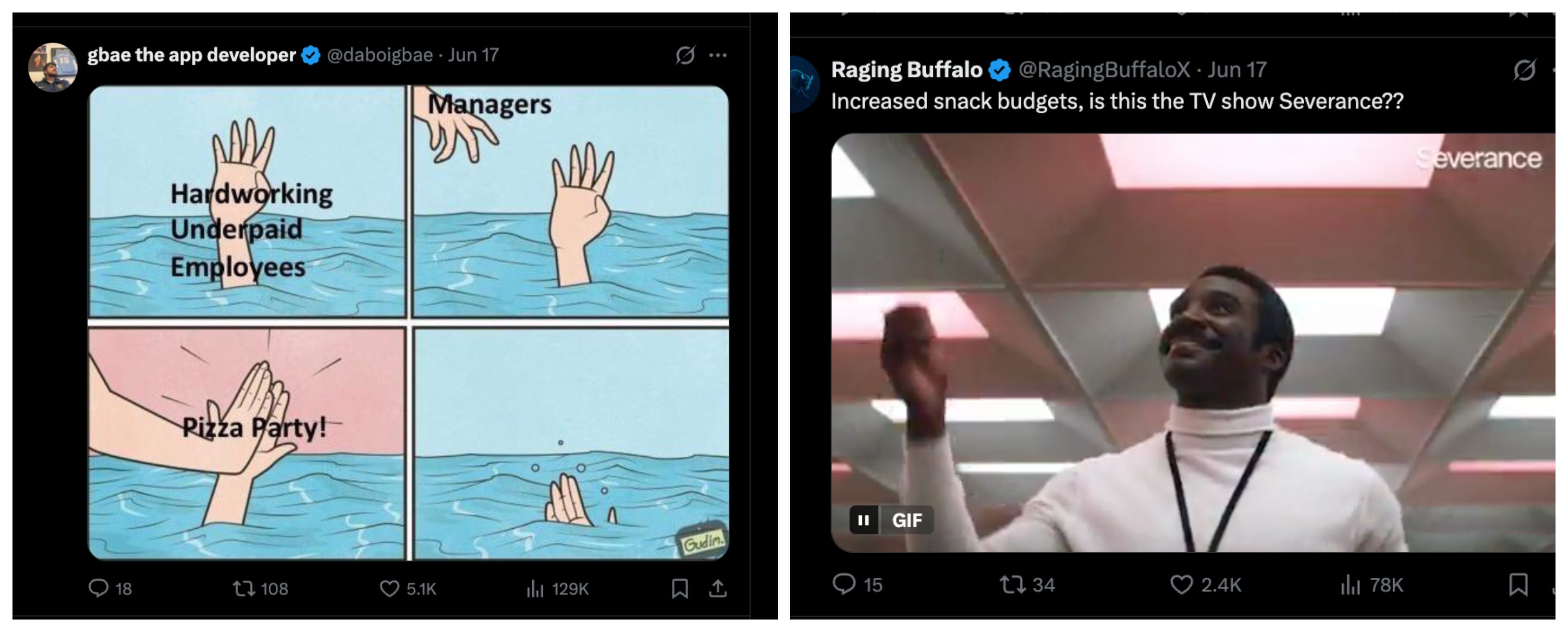
Instead of assuring workers, Meta’s attempts to contain the damage only inflamed grievances. The company’s leadership offered increased meal and travel budgets as a morale boost. On X, a nonprofit labor organizing group quipped, “No pizza party tastes as good as a union feels,” while gifs and memes mocking the company and comparing it to the dystopian TV series “Severance” collected thousands of “likes”.
Zuckerberg sent an internal memo attempting to lift spirits and revive camaraderie with a three-day AI hackathon. It got a chilly reception. Gadget Review wrote that “internal messages paint a workforce that sees the hackathon not as a gift but as uncompensated overtime dressed up with snacks.” Observers joked online: “The beatings will continue until morale improves.”
****
Now, it’s obvious that Zuckerberg, no matter what havoc he wreaks, doesn’t exactly map to Gavin Belson. Belson is overtly vain and sociopathic. Zuckerberg is more of a supercharged nerdy goofball; despite making questionable choices for his company, he appears to have a healthy family life with his wife, Priscilla Chan, and supports a range of social causes he seems to genuinely care about, like education and child health initiatives.
But there are striking parallels. In the show, Belson is constantly trailed by sycophants, a traveling echo chamber that causes him to mistake his own petty impulses for vision. His Google-like company “Hooli” launches massive, foolhardy initiatives at his whim, only to shut them down and mass-fire people when the plans inevitably end badly.
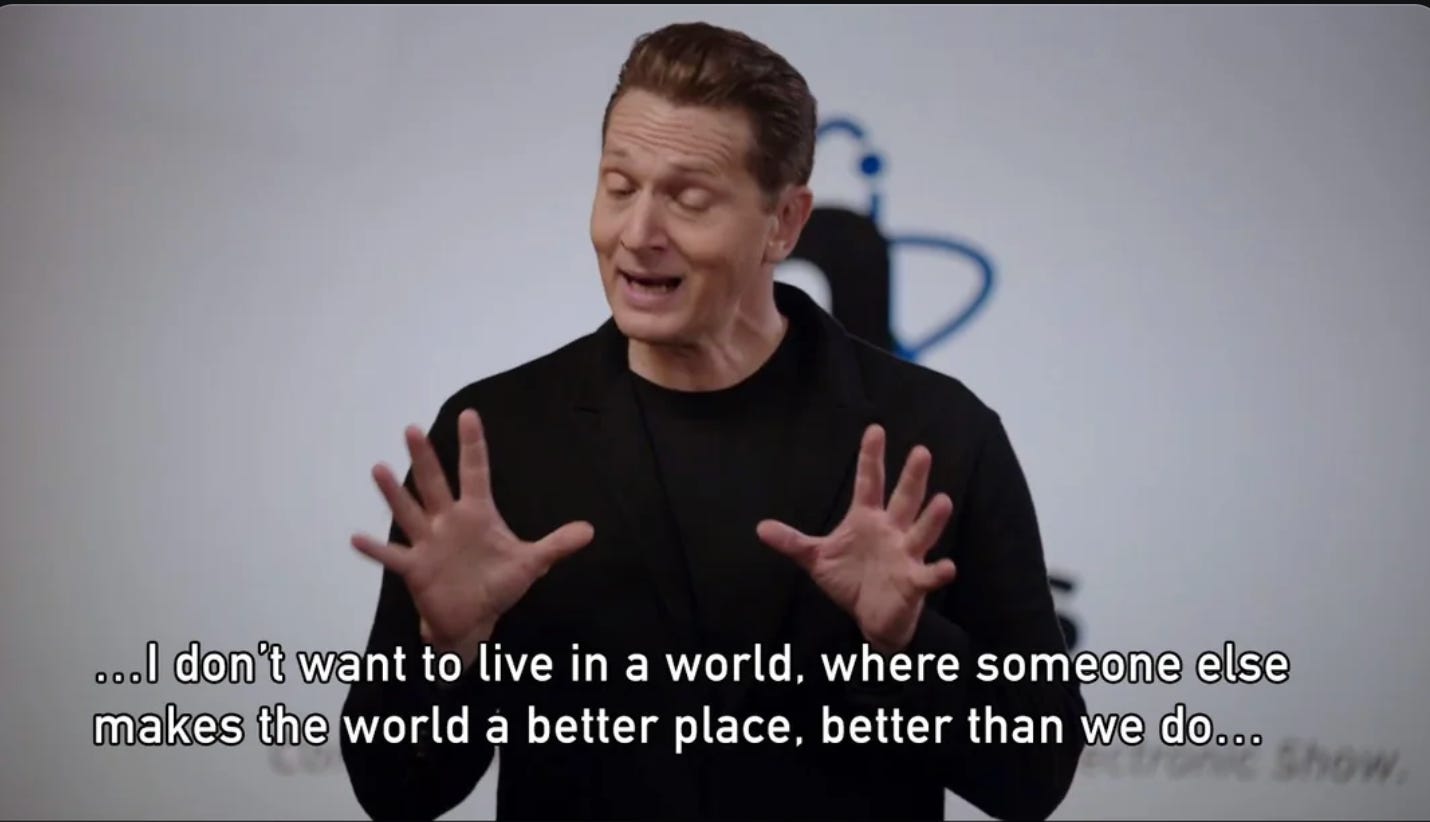
He also displays a stunning lack of self-awareness that provides fodder for some of the show’s most memorable quotes. For example, when proclaiming his supposed altruism, Belson says: “I don't want to live in a world where someone else makes the world a better place better than we do.”
The Meta chaos looks much like Hooli’s chaos. And Zuckerberg’s “hackathon” memo displays almost as much tone-deaf absurdity as Belson. While young Zuckerberg was a likely inspiration for Richard Hendricks, the middle-aged version has since drifted uncomfortably close to the Dark Side.
The problem isn’t having exotic billionaire-style interests, no matter how pointless and bizarre they may sound to the rest of us, like making Japanese swords or slaughtering your own dinner by choice. The problem is being surrounded by too many people who will only tell you what you want to hear. For Zuck, that might be hearing he can devote 100% of his focus to all his activities simultaneously and excel at them — while also keeping one of the world’s largest technology companies thriving. The problem is isolation from reality, and living in a bubble of your own making.
The irony baked into this unfolding mess at Meta is that — like many big Silicon Valley tech firms — it has been known for being generous with compensation and perks, with six-figure salaries, free food at many of its campuses, and a historical culture of encouraging job-related intellectual exploration. Compared with the typical workplace, that’s almost utopian. Zuckerberg’s mistakes were a cold and abrupt counterpoint. They are a reminder that a flash of genius that makes someone a billionaire doesn’t last forever, that hubris corrupts judgment, and that the same person who can build a great company can just as easily push it off a cliff.


