

Welcome to Black Sheep, a spin‑off of my serialized memoir, SMIRK. If you’re looking for SMIRK, here’s the link to the complete book. Black Sheep is where I now follow similar themes of fraud and folly in other companies, industries, and individuals.
Once upon a time, I considered using Black Sheep solely to cover wayward Forbes 30 under 30s. First of all, I had a personal relationship with one of the more famous ones, which you can read about in SMIRK. Second of all, it seemed like they might be numerous enough. Every year, at least a few young founders who make one of these lists (the franchise has swelled well beyond the original “30” to encompass hundreds across specific industries) end up either indicted on fraud charges or under regulatory and investor scrutiny over similar accusations.
As I explained in a previous Black Sheep post, many obvious factors contribute to this ignominious parade: media focus on hype over substance, VCs setting goalposts based on statistical anomalies rather than realistic markers of success, and young founders demonstrating eagerness to please and prove themselves without the counterbalances of maturity and experience. But there was a force operating behind the scenes that might have had an even bigger impact—a person who conceived of the list from the start, expanded it into a cultural and money-making force, and may have insulated it against concerns about its socially irresponsible effects: now-disgraced ex-Forbes editor Randall Lane.

Before I get into all the ways Lane may have boobytrapped the founder playing field, I need to give a hand to New York Times media industry reporter Ben Mullin. Judging by LinkedIn posts chronicling the process, he seized on word about Lane stepping down from Forbes in July with the intensity of a shark getting a whiff of seal’s blood. Just a few weeks after posting a request for people to contact him on Signal about Lane’s departure, the Times published his scathing scoop: Forbes Fired Top Editor After Discovering He Received Secret $6 Million Payment.
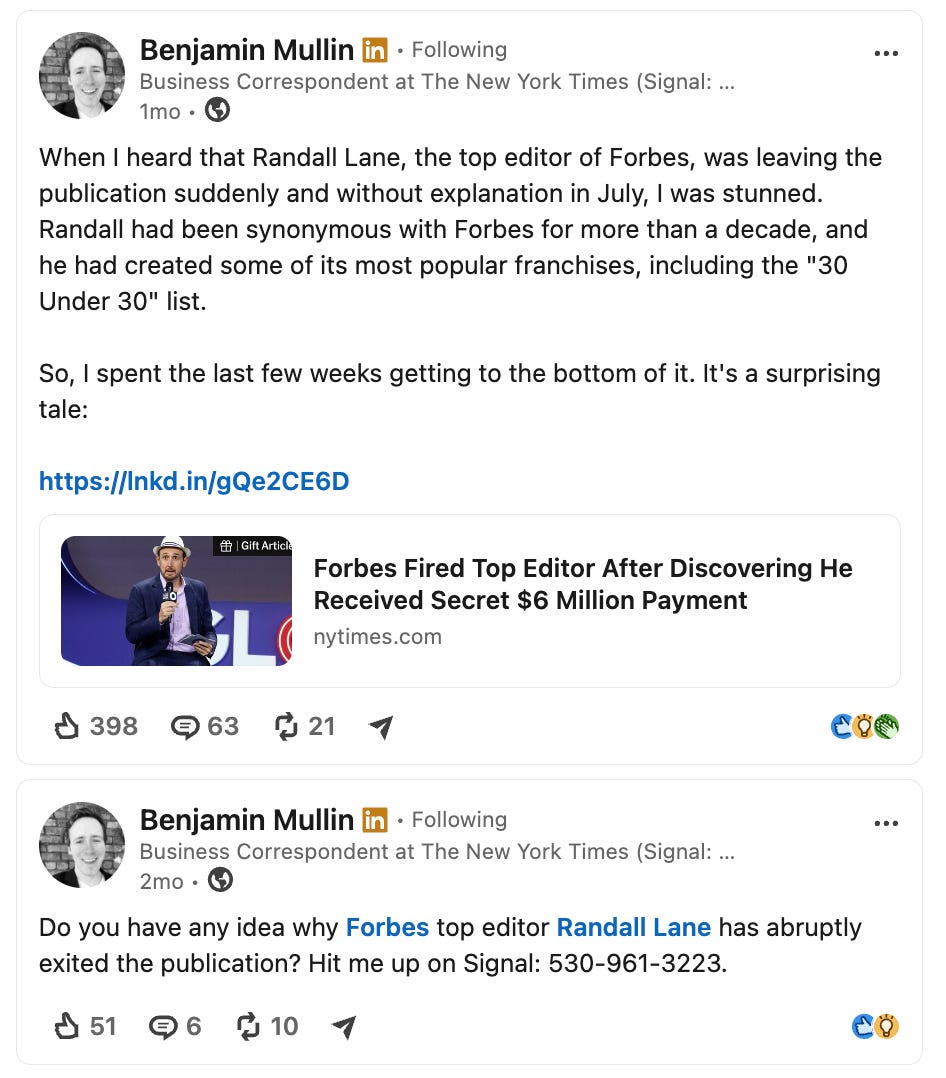
The story was both wild and utterly believable. Lane, the architect behind the “30 Under 30” franchise, had done something that was quite possibly the most unethical thing any major media editor could do, the actual unspoken implication behind an aspersion that someone had gotten “too close” to a source: He took money—like, a lot of it—from someone who had a lot to gain from favorable treatment by Forbes. Yes, when he was found out, he was fired, but the deal was done.
More specifically, as Mullin reported, Lane had taken $6 million from research company founder RJ Shook, who had partnered with the magazine to publish wealth advisor rankings. Supposedly, Lane had forged a relationship with Shook during a humanitarian excursion to Liberia, organized by Forbes, in 2013. Three years later, Shook Research began its rankings partnership with Forbes. Sources told Mullin that Lane didn’t disclose the $6 million payment to his employer “because he saw it as a personal gift from a friend.” The truth came out after Shook sold a stake to a private equity firm, which discovered the payment.
Mullin’s article included an apology from Lane but didn’t give the impression that the former editor had suffered much beyond the loss of his job as a result of his indiscretion. As a kicker, the article noted Lane had founded a competitive horse-racing association and was staging a rock musical about Benjamin Franklin, called “The Sound of America.” In other words, he was living a sort of nerdy dream as a wannabe Lin-Manuel Miranda, along with fostering a long-running hobby among America’s old-money blue bloods. So all’s well that ends well for him. I guess.
What makes this particular transgression interesting is how it fits into the broader trend of publications monetizing their influence to offset the economic squeeze in print journalism. Well-known mastheads now routinely take money from the industries they cover through sponsored events and content, while affiliate links have even turned product rankings into a source of revenue. The deals are supposed to be disclosed, of course, but the larger point is that journalistic credibility itself can be for sale.
Putting aside morality for a moment, Lane’s and Shook’s $6 million arrangement, whatever it was specifically for, looks disturbingly rational. Though Lane supposedly wasn’t in charge of Forbes’ business dealings with Shook, the founder had a direct line to Lane, the magazine’s chief content officer, using him, reportedly, as an “unofficial sounding board.” If Lane understood that his years of advice might eventually be rewarded financially, the conflict is obvious.
The situation also calls to mind one of my favorite essays on the media business, published by Chuck Klosterman in 2003 in his book “Sex, Drugs, and Cocoa Puffs.” Drawing on his experiences working at local newspapers, he wrote: “What civilians in the conventional world need to realize is that journalists are not like you. They have higher ethics and less common sense.” Klosterman was trying to argue that these qualities helped keep bias out of day-to-day reporting. But unlike local news journalists working themselves to exhaustion covering city council meetings for a salary a school teacher would revolt at, always on the verge of being laid off, the reverse might have been true for Lane: A lack of ethics and too much common sense.
What does the sensible person with no ethics do if working in a dying industry, where the greatest assets are integrity, reach, and reputation? Scale it to its highest peak, maximize the value of those things for yourself, and then cash in. For Lane, I guess the going rate was $6 million.
Back to how this all relates to the “30 Under 30”: Aside from clearly being very good at befriending the wealthy, Lane really did orchestrate the powerhouse franchise. It was one of his first major projects at Forbes, based on lists of young professionals he had started at other publications that were well-received. Launched in 2011, the “30 Under 30” took on a life of its own at Forbes, though, as it collided with a cultural obsession with finding young genius founders, especially in the tech industry.
The magazine retained enough independence over the selection of people for its 30 under 30 lists that it could call this “journalism,” making the credential valuable. In a 2019 interview published on Medium, Lane called 30 Under 30 a “true meritocracy.” Young hotshots could not pay to get themselves on the list. The honorees weren’t there because of who they knew, he insisted, but because they had accomplished extraordinary things and survived a rigorous judging process. “The integrity of the list is everything,” he said.
He also candidly explained the business model, which went far beyond publishing a list. The print editions attracted sponsors; the live events assembled thousands of ambitious young entrepreneurs and future power brokers in one place; and corporate partners got the opportunity to reach this coveted population. Lane said Forbes was selective about which brands it admitted because of the trust surrounding the Under 30 name. He referred to the franchise as a “velvet rope” experience.
Lane milked that popularity for all it was worth, expanding “30 Under 30” into networking summits, branding opportunities, and a global community. It became a cultural phenomenon, setting expectations across industries; it also peddled unsustainable mythology. The number of young “30 Under 30” founders who turned out to have been faking their way to success, though relatively small, kept rising. This has been embarrassing for Forbes — the magazine acknowledged this by publishing a “Hall of Shame” — but the franchise continued.
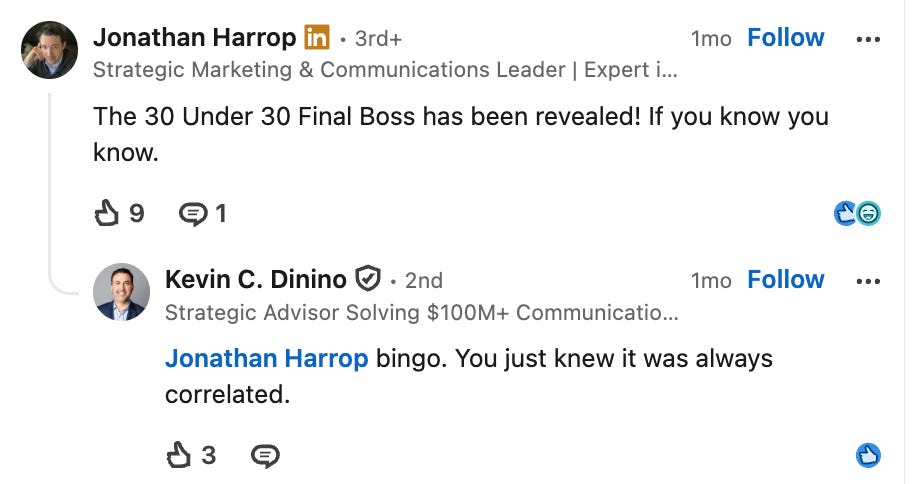
When Mullin’s exposé on Lane came out, the irony was harder for the publication to dodge. Jokes at the magazine’s expense practically wrote themselves, flooding social media. Under one of Mullin’s LinkedIn posts, a reader made the same snarky quip I thought of when writing a title for this piece. “The 30 Under 30 Final Boss has been revealed! If you know you know,” he posted. Another replied: “You just knew it was always correlated.”
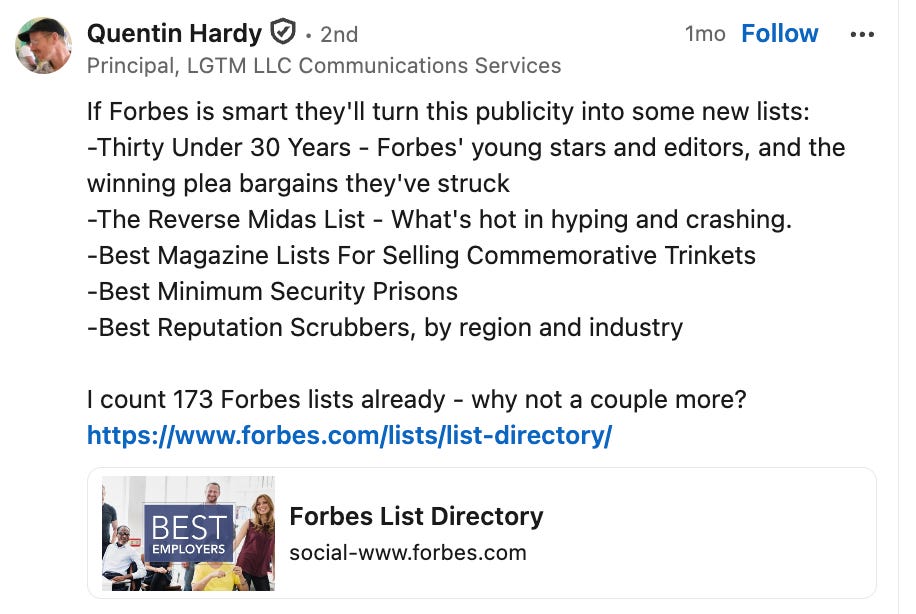
Some readers posted more substantive mockery, including one who said: “If Forbes is smart they’ll turn this publicity into some new lists,” including “Thirty Under 30 Years - Forbes’ young stars and editors, and the winning plea bargains they’ve struck” and “Best Reputation Scrubbers, by region and industry.”
All humor aside, though, there’s a more serious conclusion this leads to. It’s so cynical that most of us, including those laughing at Forbes and Lane, would probably reflexively write it off as a conspiracy theory. Still, it’s there, sitting like a lump of lead in the pits of our stomachs, poisonous, painful and unable to be purged.
The game is rigged…by people who are in it for themselves. Even those of us who manage to ascend on our own merits, doing things the “right” way and never compromising our integrity, have probably encountered a ceiling established by someone like Lane: someone who has learned how to monopolize and monetize his position as a gatekeeper to wealth and prestige.
Lane’s actions might not be a “crime” in the technical legal sense, as far as we know so far. But by perpetuating this sensibility, I would argue that the damage he did to society is far greater, and more lasting, than any fraud concocted by a striver on one of his lists.


