
It’s been a decade since the saga that gave rise to SMIRK, practically eons on the scale of social media and tabloid dramas. Still, no matter how much time passes, someone somewhere is always going to remember me as “that Martin Shkreli woman.” I’ve accepted this consequence, like a metaphorical 12-foot Home Depot skeleton I left propped up outside year-round instead of hidden in a closet. It is what it is, and life continues.
Minor annoyances aside, that episode in my life has a surprising advantage in the generative AI era. Namely, it’s given me a voice far too recognizably human to be replicated by a machine. Sure, a chatbot can generate reasonably clean and coherent prose about legal dramas — but can it do it with the knowledge and insight of a journalist who not only has decades of experience, but has seen and done what I have seen and done, made unconventional choices, and then drifted awkwardly into the center of the story? I think not.
For months, I’ve watched journalists and writers wrestle with the inevitable creep of AI into their domain. Defensive coping abounds. Just recently on X, Washington Post columnist Megan McArdle explained how she has used AI to “do research,” “transcribe interviews, generate pushback,” for her column arguments, and “fact check,” clarifying that the technology is meant to “do grunt work and help you turn in cleaner copy, not to ‘inspire’ you.” Journo/writer types responded to her balanced-sounding approach with a wave of unmitigated horror and outrage.
Highlight of their comments included “Absolutely do not do this lmao,” “Grunt work” is the work you fucking idiots,” and “Or you could just do your fucking job.” There were also more substantive rants, including some pointing out the risk of AI hallucinations, and one commenter declaring: “in less than two years, even just using an LLM as an intern, first-pass editor, and fact-checker will be so tremendously embarrassing, even career-destroying, that no one will ever admit to having adopted the technology in such a way”.
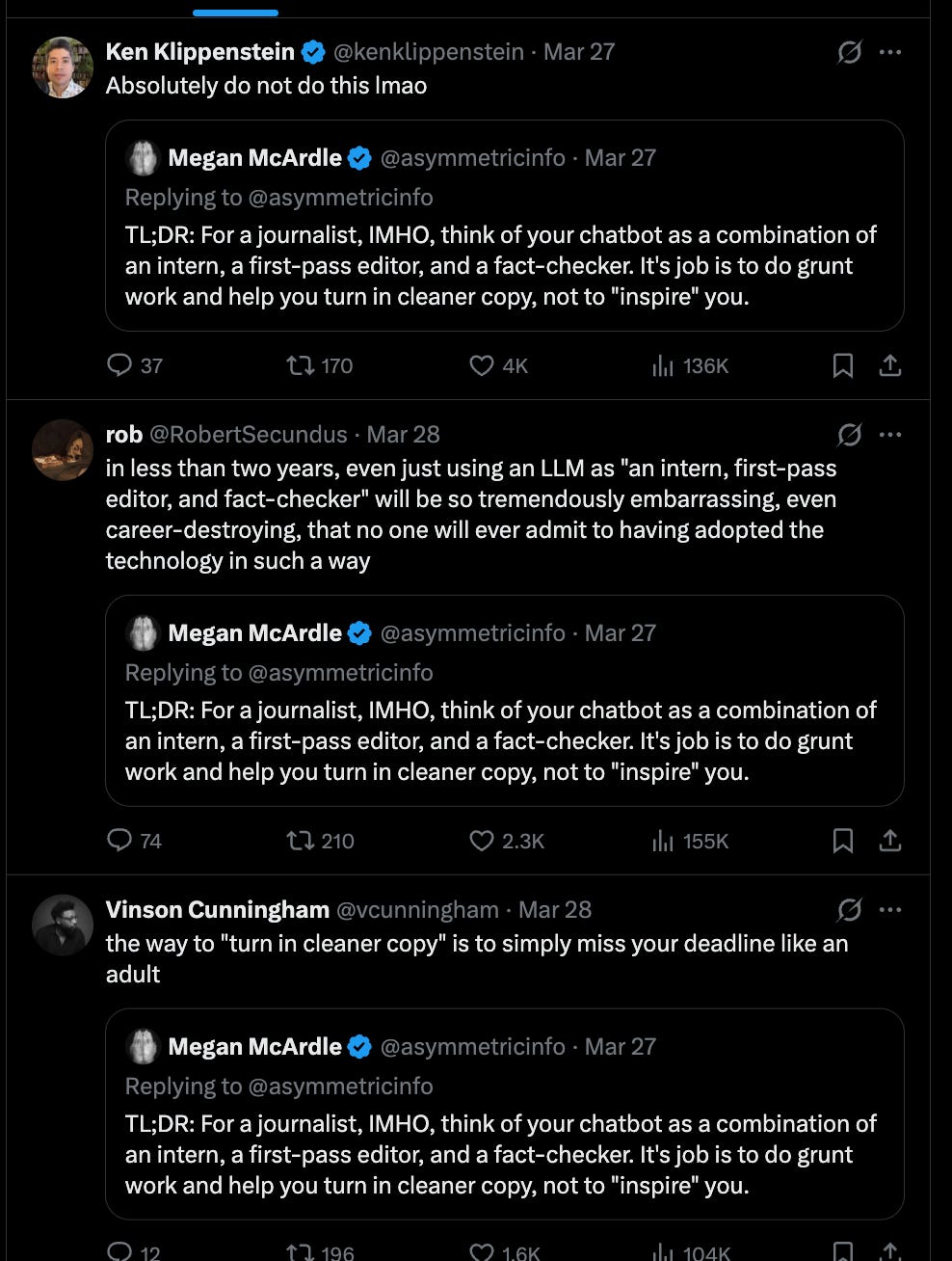
I couldn’t help but snort-laugh a little to myself as I scrolled through the quote tweets. Having been the target of one myself, I know an insecurity-triggered performative pile-on when I see one. The top-shelf, almost hopeful proclamations about “destroying” careers are a hallmark. The fact that the person being attacked has a career, and most of her detractors appear less prominent or successful in that area (at least based on their X bios), is also a strong sign.
But I get where the anger and anxiety are coming from. AI is starting to take over a task that many journalists and writers pride themselves on: weaving discordant information into clean, readable content. The economic threat is obvious. Beyond that, I see a potentially even more devastating existential crisis. If your professional ego is staked on your ability to find facts and draft clear prose, especially under deadline pressure, who are you now that a robot can do those things so much faster?
For better or worse, I do not face a similar identity crisis. While my “name” as a writer may not be as established and remunerative as McArdle’s, my sense of self as a practitioner of the craft remains secure. That’s because I don’t just find information and bang out sentences and paragraphs; I leverage my individual voice, depth of knowledge, and a compendium of unusual, sometimes emotionally brutal, human experiences in my approach. In effect, my scarlet letter is a salvation.
Any writer who brings genuine lived experience and perspective to the table, in addition to reporting skills and a flair for word choice and storytelling, isn’t going anywhere. A robot simply can’t compete. Here are some examples of what I mean.
As a reader, I’ve always gravitated instinctively to nonfiction writers who encapsulated this total package, seamlessly blending insights, experience, and facts to create work that I couldn’t imagine being created by anyone else. Among my favorites are travel memoirs by Bill Bryson, such as A Walk in the Woods, about hiking the Appalachian Trail, or Notes from a Small Island, about living in Great Britain as an American, and his trek around the country before returning to the US.
For similar reasons, I adore Sarah Vowell’s quirky history travelogues, like Assassination Vacation, and Ian Frazier’s similarly illuminating Travels in Siberia. Both write like detached observers who can also convey exactly how it feels, through their eyes, to be doing the observing. For Vowell, who didn’t drive, that meant being a weird aunt who always needed rides from family to historic murder scenes. For Frazier, that meant slogging along muddy roads for weeks in a ramshackle van and camping amid clouds of aggressive Siberian mosquitoes.
Then there’s the O.G. writer on my list, Dave Barry, whose humor columns and books I’ve read over and over again since childhood. As a journalist-turned-columnist and author who mostly just writes about his own life, he is in a class all his own, having achieved a voice so distinctive yet relatable he can write about almost anything, or even “nothing” in the Seinfeldian sense, and make people laugh — or cry, if the subject matter calls for it.
On the more serious side, I also idolize work by investigative journalists who become so immersed in their subjects that notions of detached objectivity no longer seem to apply, straying closer to obsession. At the top of this heap sits The Power Broker, by journalist Robert Caro, about iron-fist-wielding New York City public works czar Robert Moses. The hulking volume — 1,300-ish pages, with an audio version spanning more than 66 hours — is written in traditionally journalistic third person. But it is steeped in Caro’s perspective as a longtime reporter for Newsday, who was clearly driven to dismantle the do-gooder facade of a megalomaniac bureaucrat.
Similarly, when I read a hefty book by James B. Stewart about massive financial scandals and boardroom brawls, i.e. Den of Thieves, about 1980s “Junk Bond King” Michael Milken, and Disney War, a King Lear-ish take on Michael Eisner, I saw both a journalist trying to stay out of the way as a neutral storyteller, and an author who couldn’t help but reveal his cultivated point of view. Stewart graduated from Harvard Law School and worked as an associate at Manhattan-based Cravath, one of the oldest and most prestigious corporate law firms in the United States. He saw the machinery of power structures up close, and he could have made a good living as a part of it. But his artistic idealism won out, and he left that world to write about it instead.
This is the type of work that inspires me: stuff that will have enduring value regardless of how smooth or effortless AI writing can be, and regardless of what technological tools a writer employs to aid in the process. I tested these waters, developing my personal style, with SMIRK. And I’ve taken it further with Black Sheep as a spin-off section, where I write stories in a way that I feel only I can tell them, adding texture and dimensionality.
You can see all that in a recent series of posts I did called A Ponzi Scheme on the Prairie. I took a story that had been covered somewhat by the mainstream press about a young man in the Midwest who allegedly ran a cattle-based investment scam and drew out complicating threads others hadn’t noticed. The result is a three-act plot touching on themes of rural American culture, pushback against factory farming, pride, family values, and betrayal. Not bad for a person writing a Substack in her spare time without an editor. (In the interest of full disclosure regarding SMIRK and Black Sheep: I use AI to help locate research materials, for high-level structural feedback, and to fix typos. But the words and ideas are all mine.)
Regardless of whether Silicon Valley’s army of chatbots reshapes media as we know it, I intend to keep writing these kinds of pieces to shed light into dark crevices, to inform, and to entertain. Is this a path to maximum prosperity? Probably not. Great human writing, the kind with personal voice and risk, has never been about ROI. And that’s the beauty of it. Writers who produce work of intrinsic value don’t need to show compound growth to venture capitalists or become billionaires to leave an impression on the world. All we need to do is amass experiences, observe the human condition, and tell our stories.